Welcome to your new life in the sun! Whether you are treating yourself to a tapas dinner, paying your utility bills, or setting up a freelance business in Madrid, there is one acronym you will see on almost every receipt: IVA. Understanding how the Spanish IVA works is an unavoidable part of settling into the country. It affects the daily cost of living for expats and introduces strict quarterly obligations for anyone running a business.
Navigating a foreign tax system can feel overwhelming, especially when the rules seem to change every few years. However, once you grasp the basic tiers and how they apply to your purchases or invoices, managing this tax becomes second nature. Let’s break down the rules for 2026 so you can budget effectively and keep the local tax authorities happy.
What exactly is the Spanish IVA?
The Spanish IVA stands for Impuesto sobre el Valor Añadido. In English, this translates to Value Added Tax (VAT), or sales tax. It is an indirect consumption tax levied on almost all goods and services bought and sold within the country. Unlike income tax, which is based on how much you earn, IVA is a flat rate applied to the price of the item or service you are buying.
The entity in charge of collecting and monitoring this tax is Hacienda (the Spanish Tax Agency). As an end consumer, you pay the tax directly to the shop or service provider, who then passes it on to Hacienda.
The three official tax brackets
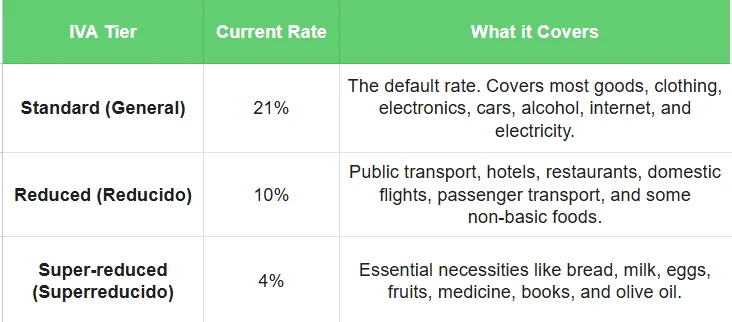
Unlike some countries that apply a single flat rate to everything, Spain divides its consumer goods and services into three distinct categories. Knowing which category your purchases fall into will help you anticipate your living costs.
Recent changes to the Spanish IVA you should know
If you lived or vacationed here over the past few years, you might have noticed some temporary tax cuts implemented to combat inflation. As of 2026, those emergency measures have officially ended, returning the fiscal landscape to normal.
For example, the tax on electricity and gas has reverted to the standard 21%, meaning your winter heating bills will reflect this higher rate. Basic supermarket staples, which briefly enjoyed a 0% rate, have also returned to their traditional 4% super-reduced bracket. However, there is one delicious exception: olive oil. Due to its cultural and dietary importance, the government has permanently classified olive oil as a basic necessity, locking its Spanish IVA rate at 4%.
How the Spanish IVA works for an Autónomo
If you decide to work for yourself and register as an Autónomo (a legally registered freelance or self-employed worker in Spain), your relationship with this tax completely changes. You are no longer just a consumer; you become an unpaid tax collector for the government.
Whenever you provide a service or sell a product, you must add the applicable 21% or 10% rate to your factura (invoice). Your client pays you the total amount, but that extra tax money is not yours to keep. Every three months, you must submit a quarterly tax return (Modelo 303) to Hacienda, handing over all the IVA you have collected.
Deducting your business expenses
The silver lining for an Autónomo is that you can deduct the IVA you pay on legitimate business expenses. If you buy a laptop for your graphic design business and pay 21% tax on it, you can subtract that amount from the IVA you owe the government at the end of the quarter. Keeping meticulous records and hiring an English-speaking gestor (an administrative accountant) is highly recommended to ensure you claim your deductions correctly without triggering an audit.
The Spanish IVA on real estate purchases
Buying a property is often the biggest financial transaction an expat will make. If you are purchasing a brand-new home directly from a developer, you will be required to pay the Spanish IVA on the transaction. The rate for new residential properties is set at 10% of the purchase price. However, if you are buying a resale property (a home that has had previous owners), you do not pay IVA; instead, you pay a different regional tax known as ITP (Impuesto sobre Transmisiones Patrimoniales), which typically ranges from 6% to 10% depending on the region.
The Canary Islands Exception: Say goodbye to IVA
Are you planning to move to Tenerife, Gran Canaria, or Lanzarote? If so, you can forget about the Spanish IVA altogether. The Canary Islands operate under a completely different fiscal regime designed to boost their local economy and offset the costs of being geographically isolated.
Instead of IVA, the islands use the IGIC (Impuesto General Indirecto Canario). The standard IGIC rate is currently just 7%, which is a massive drop from the mainland’s 21%. This makes everything from dining out to buying a car significantly cheaper. However, if you are a freelancer based in the Canary Islands but billing clients in mainland Spain, you must navigate specific invoicing rules to determine which tax applies.
Whether you are buying a home, doing your weekly grocery shopping, or launching a new startup, sales tax is an unavoidable part of your financial life here. By familiarizing yourself with the different rates, keeping your invoices organized, and knowing exactly what you can deduct, you can stay fully compliant with the authorities. Take control of your financial planning today, and you will be able to enjoy the unparalleled Spanish lifestyle without any unexpected tax surprises.
Frequently Asked Questions (FAQs)
Do I have to charge IVA if my client is outside of Spain?
If you are a Spanish freelancer billing a client located outside of the European Union (like the US or UK), you generally do not charge IVA. If your client is a registered business within another EU country, you can also invoice without IVA using the Reverse Charge mechanism, provided both of you have a valid VIES VAT number.
Can tourists claim a refund on the Spanish IVA?
Yes, if you are a non-EU resident visiting Spain on holiday, you can claim a tax refund on goods purchased for personal use that you take back to your home country. This applies to items like clothing and electronics, but not to services like hotel stays or restaurant meals. You must request a Tax-Free form at the store and scan it at the airport kiosk before leaving the EU.
What happens if I miss the quarterly IVA deadline as a freelancer?
Hacienda is very strict with deadlines. If you file your quarterly return late, you will automatically face a surcharge (usually starting at 1% and increasing the longer you delay). If the tax office discovers the missing payment before you voluntarily declare it, they will also apply substantial financial penalties on top of the owed tax.
If you need personalized assistance, at Entre Trámites we offer management and tax advisory services for freelancers and SMEs. You can contact us through this contact form for us to call you, or if you prefer, you can schedule a free consultation or write to us on WhatsApp.