Setting up a business in Spain offers incredible access to the European market. Whether you are launching a tech startup in Barcelona or working as a freelance consultant from the sunny coast of Valencia, doing business across borders is easier than ever. However, if your clients or suppliers are located in other European Union countries, you need to understand the local cross-border tax rules.
If you want to trade goods or services seamlessly within the EU without losing money on double taxation, getting your business into the register of intra-community operators is absolutely essential. Let’s break down exactly what this registry is, why you need it, and how to get approved without getting tangled in Spanish bureaucracy.
What is the register of intra-community operators?
In Spain, this database is known locally as the ROI (Registro de Operadores Intracomunitarios). It is a special census managed by Hacienda (the Spanish Tax Agency). When you are successfully added to this registry, you are assigned a specific intra-community VAT number, which is simply your standard Spanish tax ID prefixed with “ES” (for example, ESX1234567Z).
This local database is directly linked to VIES (the VAT Information Exchange System), which is the overarching European database. Being on this list proves to other European businesses that you are a legitimate, tax-paying entity in Spain. Whether you are registered as an Autónomo (a registered self-employed professional) or you run an SL (Sociedad Limitada – a Limited Liability Company), you must apply for this status if you want to perform B2B (Business-to-Business) operations within the EU.
Why You Must Apply for the register of intra-community operators
The primary reason to join this registry is purely financial: it dictates how you handle IVA (Impuesto sobre el Valor Añadido – the Spanish Value Added Tax).
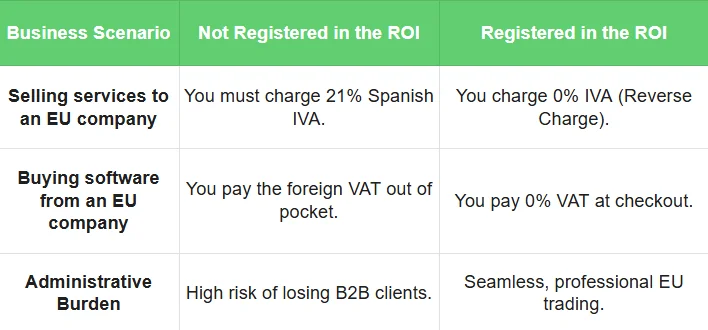
If you are selling digital marketing services to a company in Germany, or you are buying software subscriptions from a supplier based in Ireland, you want to use the “reverse charge mechanism.” This mechanism allows you to issue and receive invoices with 0% VAT. Enrolling in the register of intra-community operators is the only legal way to unlock this 0% VAT benefit for cross-border EU trade.
Here is a clear comparison of how your billing changes depending on your registration status:
Step-by-Step: Joining the register of intra-community operators
Applying for this status requires dealing directly with the Spanish tax authorities. In 2026, the entire process is digital, but it requires precision.
Step 1: Obtain Your Digital Identity
Before you can submit any paperwork to the government, you need a Certificado Digital (a secure digital identity certificate installed on your computer). This allows you to securely access the Agencia Tributaria online portal and sign documents legally.
Step 2: Submit Form 036
To request inclusion in the registry, you must file Modelo 036 (the full census declaration form). Do not confuse this with the simplified Modelo 037, which does not contain the specific checkboxes needed for intra-community registration. You will need to tick box 582 to request your registration, and specify the exact date you plan to start your European operations.
Step 3: Prepare for Hacienda’s Verification
Approval is not automatic. The Spanish government actively fights “carousel fraud” and fake VAT numbers. Therefore, when you apply for the register of intra-community operators, Hacienda will likely put your application under review to verify that your business is real.
What to Expect During the Inspection
The tax office has up to three months to approve or deny your request. During this time, they may send an inspector to your registered business address. If you work from home, they might request documentation via the online portal instead. Be prepared to show proof of your European intent, such as:
- Proforma invoices from EU suppliers.
- Email threads negotiating contracts with EU clients.
- A solid business plan explaining why you need to trade internationally.
Your Obligations Once Approved
Once you receive the green light and your VAT number becomes active on the European VIES database, your life gets easier financially, but your reporting requirements increase.
You must now submit Modelo 349 (an informative declaration of intra-community operations) either monthly, quarterly, or annually, depending on your trade volume. This form tells the Spanish government exactly who you traded with in the EU and for how much.
Keep Your Status Active
Use it or lose it. If you go an entire year without declaring any cross-border EU operations on your Modelo 349, the tax office will automatically remove you from the registry, and you will have to start the grueling application process all over again.
Getting your intra-community tax status sorted is a crucial milestone for your Spanish business. It instantly makes you more competitive across Europe, prevents you from overpaying on software and supplies, and establishes you as a serious international player. Keep your documentation organized, apply early, and watch your borderless business thrive.
Frequently Asked Questions (FAQs)
What happens if I invoice an EU client while waiting for my ROI approval?
If your application is still pending, you cannot use the 0% VAT reverse charge. You are legally required to add standard Spanish VAT (usually 21%) to your invoices to other EU businesses until your intra-community VAT number is officially active and verified on VIES.
Can I deduct the IVA I paid to European suppliers before I was registered?
Generally, no. If you purchase services or goods from an EU country without a valid intra-community VAT number, the supplier will charge you their local VAT. You cannot easily deduct or reclaim this foreign VAT through your standard quarterly Spanish tax returns.
Do I need to join this register if I only sell to individuals (B2C) in Europe?
No. The register is strictly for Business-to-Business (B2B) transactions. If you are selling physical goods or digital services directly to consumers (B2C) in other EU countries, you operate under different rules, such as the OSS (One-Stop Shop) scheme, and do not need an intra-community VAT number.
If you need personalized assistance, at Entre Trámites we offer management and tax advisory services for freelancers and SMEs. You can contact us through this contact form for us to call you, or if you prefer, you can schedule a free consultation or write to us on WhatsApp.