Starting a business in the sun-drenched Iberian Peninsula is an exciting venture for any expat, digital nomad, or foreign investor. However, while the lifestyle is incredibly appealing, navigating the local bureaucracy can initially feel overwhelming. If you are planning to incorporate a business, understanding how company taxes in Spain work is absolutely vital for your financial success.
Whether you are launching a tech startup in Barcelona, opening a boutique hotel in Andalusia, or managing a remote consultancy, knowing your fiscal obligations from day one will save you time, money, and headaches. Let’s break down everything you need to know about corporate taxation so you can focus on growing your business instead of worrying about the paperwork.
How do company taxes in Spain work?
When you set up a formal corporate entity, such as an S.L. (Sociedad Limitada – Limited Liability Company), you become liable for the Impuesto sobre Sociedades. This is the official Spanish term for corporate income tax, which is levied on the worldwide profits of resident companies.
The system is overseen by Hacienda (the Spanish Tax Agency). As a business owner, you must regularly report your earnings to Hacienda, ensuring your accounting complies with national standards. Fortunately, the rates are highly structured, and there are several incentives designed to attract new businesses to the country.
Current rates for company taxes in Spain
The amount of tax your business will pay depends heavily on its size, age, and revenue. For the fiscal year 2026, the Spanish government maintains a competitive and tiered tax structure.
The standard corporate tax rate
For most established medium and large businesses, the general corporate tax rate sits at 25%. This rate applies to your net profit—meaning your total revenue minus all allowable deductible business expenses, such as salaries, office rent, and professional services.
The reduced rate for newly created entities
To encourage entrepreneurship, Spain offers a fantastic incentive for brand-new companies. If your business qualifies as a newly created entity, your corporate tax rate is drastically reduced to just 15%. This reduced rate applies to the first year your company declares a taxable profit, as well as the following year.
Benefits for startups and smaller businesses
If your business is officially certified under the Startup Law, you can maintain that beneficial 15% rate for up to four years. Additionally, micro-enterprises and SMEs (Small and Medium-sized Enterprises) with a turnover of less than €1 million often benefit from reduced effective rates, generally hovering around 23%.
Comparing structures: Freelancers vs. Limited Companies
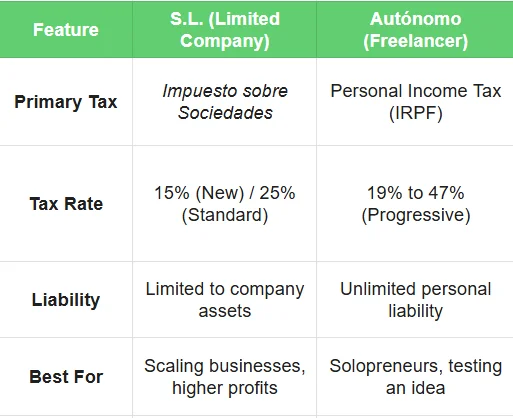
Many expats debate whether to register as a sole trader or incorporate a full company. If you operate as an Autónomo (the Spanish term for a registered freelance worker or sole trader), you do not pay company taxes in Spain. Instead, your business profits are taxed under the progressive personal income tax system (IRPF), which can reach up to 47% for high earners.
Here is a quick comparative breakdown to help you visualize the difference:
Other essential taxes for your Spanish business
While corporate income tax is your main focus, it is not the only fiscal obligation. You also need to manage indirect taxes.
The most common one is IVA (Impuesto sobre el Valor Añadido – Value Added Tax). The standard rate is 21%, though reduced rates of 10% and 4% apply to specific goods and services. As a business, you act as a tax collector: you charge IVA to your clients, pay IVA on your business purchases, and then settle the difference with the tax agency on a quarterly basis.
Filing your company taxes in Spain efficiently
You cannot simply wait until the end of the year to pay your taxes. The Spanish system requires you to make advance quarterly payments (pagos fraccionados).
These prepayments are typically filed in April, October, and December, and are calculated based on your previous year’s tax liability or your ongoing profits. Then, your final annual corporate tax return is filed within 25 days after six months from the end of your fiscal year—which usually means July 25th for most companies operating on a standard calendar year.
Missing these deadlines can result in severe financial penalties and late payment interest rates. Because the regulatory landscape is strict, it is highly recommended to partner with a trusted Gestor (a specialized Spanish administrative agent) or an English-speaking accountant who can submit these filings electronically via a Digital Certificate on your behalf.
Navigating the financial landscape as a foreign entrepreneur does not have to be a nightmare. By understanding the standard rates, utilizing the available startup deductions, and relying on qualified local experts, you can build a highly profitable venture. Master your tax obligations early, and you will set a strong, legally compliant foundation for your company’s long-term success in the Spanish market.
Frequently Asked Questions (FAQs)
Are foreign-owned companies taxed differently in Spain?
No, if your company is incorporated in Spanish territory, it is treated as a resident company. It will be subject to the exact same corporate tax rules and rates as a company owned by Spanish citizens.
Can I deduct my business expenses to lower my corporate tax bill?
Absolutely. Legitimate business expenses that are properly documented with formal invoices (facturas) can be deducted from your gross income. Common deductions include employee salaries, marketing costs, office supplies, and professional consulting fees.
What happens if my company makes a loss in its first year?
If your company does not generate a profit, you do not pay corporate income tax for that year. Furthermore, you can carry forward these tax losses to offset future profits, which will effectively reduce your tax burden when your business eventually becomes profitable.
If you need personalized assistance, at Entre Trámites we offer management and tax advisory services for freelancers and SMEs. You can contact us through this contact form for us to call you, or if you prefer, you can schedule a free consultation or write to us on WhatsApp.