Moving to the Iberian Peninsula or simply planning an extended Mediterranean getaway is incredibly exciting. However, before you start hunting for an apartment in Valencia or packing your bags for Madrid, you must address the legal realities of crossing the border. If you are an American, British, or Canadian citizen, the most pressing question on your mind is likely: do I need a visa to Spain?
The answer depends entirely on your passport, how long you plan to stay, and what you intend to do while you are there. Navigating immigration rules does not have to be a tangled web of bureaucracy. Let’s break down the current regulations so you can organize your trip or your relocation seamlessly.
So, do I need a visa to Spain for a short visit?
If you hold a passport from a visa-exempt country—such as the United States, the United Kingdom, Australia, or Canada—and you are traveling strictly for tourism, visiting family, or attending short business meetings, you generally do not need a visa for short stays.
You fall under the standard Schengen rule, which allows you to remain in the Schengen Area for up to 90 days within any 180-day period. However, crossing the border in 2026 looks a bit different than it used to.
The Entry/Exit System (EES)
As of April 2026, the European Union fully rolled out the EES. This automated IT system replaces physical passport stamping. When you arrive at a Spanish airport or border crossing, you will scan your passport, have your photo taken, and provide your fingerprints. This biometric system tracks your exact entry and exit dates to ensure you do not overstay your 90-day limit.
ETIAS is on the horizon
While you may not need a traditional visa right now, you should be prepared for the European Travel Information and Authorisation System (ETIAS). Scheduled to launch in the final quarter of 2026, this is an electronic travel authorization—similar to the US ESTA. Before boarding your flight, you will need to fill out a quick online form and pay a small fee to get pre-approval for your visa-free trip.
When the answer to “do I need a visa to Spain” is a definite yes
If your plans involve staying longer than 90 days, getting a local job, or studying full-time, the tourist rules no longer apply. You must apply for a specific residence permit through the Spanish consulate in your home country before you arrive.
Here are the most popular routes for English-speaking expats:
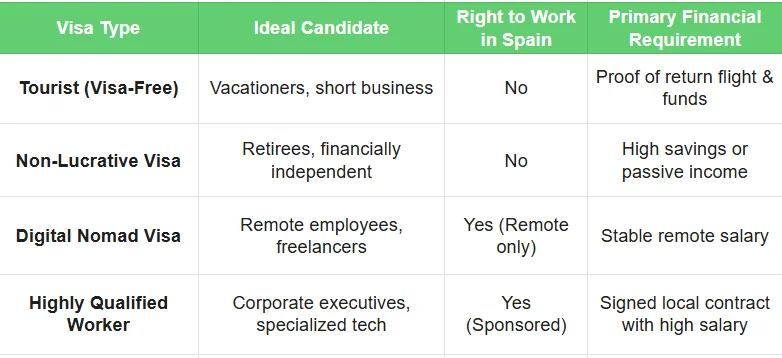
Perfect for retirees or individuals with substantial savings, the NLV allows you to live in Spain without the right to work. You must demonstrate that you have sufficient passive income (like a pension or rental earnings) or enough money in your bank account to support yourself without taking a job from a local resident.
This is the holy grail for remote workers. If you are employed by a non-Spanish company or you are a freelancer with international clients, this visa allows you to live and work remotely from Spain. You must prove a stable income that meets a specific multiple of the Spanish minimum wage, alongside comprehensive health coverage.
Standard Work Permits
If you want to be hired by a local Spanish company, the process is notoriously difficult. A standard work permit requires the company to prove that the position could not be filled by a Spanish or EU citizen. Because of this high hurdle, most expats opt for remote work or self-employment routes instead.
Here is a quick overview of how these options compare:
Essential terms to know once your visa is approved
Securing the visa in your passport is only half the battle. Once you arrive in the country to start your new life, you will immediately encounter the local bureaucracy. Understanding two critical acronyms will make your first month much smoother.
Your Spanish tax number
You will need a NIE (Número de Identidad de Extranjero – Foreigner Identity Number). This is your unique, lifelong identification and tax number in Spain. You need it to open a bank account, sign a rental lease, and set up your internet connection. Often, your NIE is assigned when your initial visa is approved.
Your physical residency card
Within 30 days of entering the country on your long-term visa, you must apply for a TIE (Tarjeta de Identidad de Extranjero – Foreigner Identity Card). This is the physical biometric plastic card that proves your legal residency status and your right to live in the country. You get this by booking an appointment at the local immigration police station.
Navigating the application process successfully
When people ask, “Do I need a visa to Spain?”, they often underestimate the timeline to get one. You cannot simply apply a week before your flight.
The Spanish government requires extensive documentation, including criminal background checks and marriage certificates. Furthermore, these foreign documents must carry an Apostille (an international legal certification) and be translated into Spanish by a sworn official translator. This preparation alone can take months. Always consult the official Spanish Ministry of Foreign Affairs website for the exact checklist corresponding to your consulate.
Whether you are dreaming of a short tapas tour in Andalusia or planning to relocate your entire life to the Mediterranean coast, knowing your legal boundaries is the first step. By understanding the new border systems and choosing the correct residency path, you can avoid stressful bureaucratic roadblocks and start enjoying the incredible lifestyle that Spain has to offer.
Frequently Asked Questions (FAQs)
Will my US or UK driver’s license work if I move to Spain?
If you are visiting as a tourist, you can use your foreign license along with an International Driving Permit. However, once you become a legal resident, US citizens must take the Spanish driving test to get a local license, whereas UK citizens can currently exchange their British license for a Spanish one under a reciprocal agreement.
Does buying property automatically give me a residency visa?
No. While owning a home is great, simply purchasing property does not grant you the right to live in Spain year-round. Since the Golden Visa via real estate investment was restricted, you must qualify for another visa type, such as the Non-Lucrative Visa, to stay legally as a resident.
Can I look for a job while visiting Spain on a 90-day tourist stay?
You can network and attend interviews, but you cannot legally start working or change your tourist status to a standard work permit from within the country. If a Spanish company wants to hire you, you generally must return to your home country to process the official work visa application through the Spanish consulate.
If you need personalized assistance, at Entre Trámites we offer management and advisory services on immigration matters. You can contact us through this contact form for us to call you, or if you prefer, you can schedule a free consultation or write to us on WhatsApp.