If you are dreaming of spending your golden years sipping wine in Andalusia, walking the sunny promenades of Alicante, or enjoying the vibrant culture of Madrid, you are in the right place. Moving to a new country can feel like a maze of paperwork, but getting your Spain retirement visa does not have to be an overwhelming process.
This guide is designed to help you, the future expat, navigate the Spanish bureaucracy smoothly. We will break down the exact requirements, financial thresholds, and legal steps you must take to make your Mediterranean retirement a reality.
What Exactly is the Spain Retirement Visa?
When expats talk about a Spain retirement visa, they are officially referring to the Visado de Residencia No Lucrativa (Non-Lucrative Visa). This is a special residence permit designed for non-EU citizens who want to live in Spain without engaging in any professional or economic activity within the country.
In short: you are allowed to live and relax in Spain, but you strictly cannot work or run a business there. To qualify, you must prove that you are entirely financially independent and have the means to support yourself without relying on the Spanish state.
The Real Financial Requirements for 2026
The Spanish government is very strict about proving your financial stability. To measure this, they use the IPREM (Indicador Público de Renta de Efectos Múltiples, the official public income index used to calculate minimum thresholds for subsidies, grants, and visas).
For the year 2026, the IPREM remains set at €600 per month. To be approved as the main applicant, you must demonstrate a steady passive income (such as pensions, dividends, or rental income) or hold liquid savings equivalent to 400% of the IPREM.
Here is a breakdown of the exact financial requirements depending on your family size:
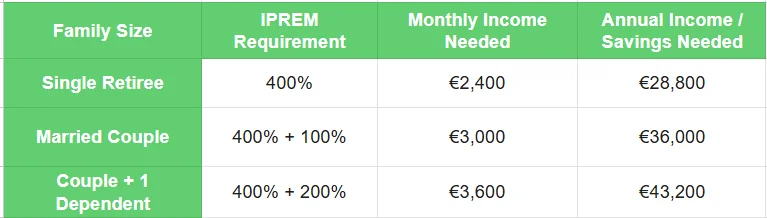
If you are relying on bank savings instead of a monthly pension, the funds must be immediately accessible, clearly in your name, and backed by officially stamped and verified bank statements.
Tax Implications for Retirees in Spain
A common misconception about the Spain retirement visa is that you do not have to pay taxes because you are not working. This is entirely false!
To maintain and renew your residency, you are legally required to live in Spain for at least 183 days a year. Once you cross this 183-day mark, you automatically become a Spanish tax resident. This means you must declare your worldwide income to Hacienda (the Spanish Tax Agency). Your foreign pensions, capital gains, and investment dividends will be subject to Spanish income tax rates.
Depending on the specific region you move to and your total global assets, you might also have to file for the Impuesto sobre el Patrimonio (Wealth Tax). We highly recommend consulting a cross-border tax advisor before moving, as Spain has double-taxation treaties with countries like the US and the UK that can protect your wealth and prevent you from being taxed twice on the same income.
Essential Paperwork and the Application Process
Gathering your documents is the most crucial part of applying. All foreign documents must be legalized (typically with a Hague Apostille) and translated into Spanish by a certified sworn translator.
Comprehensive Medical Insurance: You are required to hold private health insurance from a company authorized to operate in Spain. The policy must offer full coverage with zero co-payments (sin copagos) and no waiting periods. If you are a UK pensioner, you might be able to use an S1 form to access the Spanish public health system instead.
Medical Certificate: A formal doctor’s note stating you do not suffer from any contagious diseases with serious public health repercussions according to international regulations.
Criminal Record Check: A clean background check from every country you have legally lived in for the past five years.
Step 1: Submit your application. You must apply at the Spanish Consulate (or an outsourced agency like BLS International) in your home country. You cannot apply while already in Spain on a tourist visa.
Step 2: Wait for processing. Consulates typically take 1 to 3 months to approve your file. Once approved, you will receive a 90-day visa stamped in your passport.
Step 3: Register in Spain. Upon arriving in Spain, you must immediately secure your Empadronamiento (the official registration of your address at the local town hall).
Step 4: Get your residency card. Within 30 days of arrival, you must apply for your TIE (Tarjeta de Identidad de Extranjero, your physical foreigner identity card) at the designated national police station.
Frequently Asked Questions (FAQs)
Can I switch from a retirement visa to a working visa later?
Yes. After completing your first full year of legal residency on the Non-Lucrative Visa, you are allowed to modify your permit. If you decide to come out of retirement, you can switch to a regular work visa (if you find a Spanish employer willing to sponsor you) or a self-employed visa (if you submit a viable business plan to work for yourself).
Do I need to buy a property to qualify for this visa?
No, buying real estate is absolutely not a requirement. You can perfectly rent a home. However, you will need to provide a valid long-term rental contract to prove you have proper accommodation when applying for your initial visa and your subsequent residency card.
How long is the visa valid for, and how do I renew it?
Your initial visa and physical residency card are valid for one year. When you renew it, the next permit will be valid for two years. Keep in mind that for the two-year renewal, you will need to prove you have double the financial means (for example, €57,600 in savings for a single person) to cover that entire upcoming 24-month period.
Relocating to the Iberian Peninsula is an exciting milestone, and securing your Spain retirement visa is the primary key to unlocking your new lifestyle. By understanding the strict IPREM financial rules, gathering your apostilled documents with care, and proactively planning for your tax obligations, you will be setting yourself up for a stress-free transition. Take your time with the paperwork, seek professional advice when needed, and get ready to enjoy the incredible food, wonderful climate, and vibrant culture that Spain has to offer!
If you need personalized assistance, at Entre Trámites we offer management and advisory services on immigration matters. You can contact us through this contact form for us to call you, or if you prefer, you can schedule a free consultation or write to us on WhatsApp.