Last updated: October 2026 – Content reviewed according to current regulations.
To legally operate an e-commerce in Spain, you must register your economic activity with the Tax Agency, charge the appropriate VAT, and ensure your website complies with strict consumer protection and data privacy laws.
Who it applies to: Any individual (freelancer) or company residing in Spain, or foreign entities conducting regular online sales targeting the Spanish market.
When it does not apply: Individuals making occasional, isolated sales of second-hand personal items on consumer-to-consumer apps (like Wallapop) that do not constitute a regular business activity.
Step 1: Legal Business Registration
Before launching your e-commerce in Spain, you must formally register your business. The Spanish Tax Agency (AEAT) requires all recurring economic activities to be registered, regardless of your initial revenue.
Freelancer (Autónomo) vs. Limited Company (SL)
You have two main paths for incorporation:
- Autónomo (Freelancer): The fastest route. You register with the RETA (Special Regime for Self-Employed Workers). As of 2026, the monthly Social Security quota is progressive, based on your real net income brackets.
- Sociedad Limitada (SL): Recommended if you expect high billing or want to protect your personal assets. This involves drafting articles of incorporation, depositing share capital, visiting a notary, and registering at the Mercantile Registry.
Tax Agency Registration (Form 036 or 037)
You must submit Form 036 or 037 to the Tax Agency to register your activity. For an online store, you need to select the correct IAE (Economic Activity Tax) heading. For example, heading 665 applies to retail trade by mail or internet. If you plan to sell across the EU, you must also explicitly check the box to register in the ROI (Registry of Intra-Community Operators) to obtain your VAT number for cross-border B2B transactions.
Step 2: Tax Obligations and VAT (IVA) Compliance
Operating an e-commerce in Spain involves strict quarterly and annual tax filings. Do not skip these, as the Tax Agency heavily penalizes undeclared online sales.
Personal Income Tax (IRPF) and Corporate Tax
If you are an autónomo, you generally file Form 130 quarterly to make advance Personal Income Tax (IRPF) payments based on your net profit (revenue minus deductible expenses)—which is mandatory for B2C e-commerce since retail invoices do not carry withholding taxes. If you operate as an SL, your business profits are subject to Corporate Tax (Impuesto sobre Sociedades).
VAT Compliance and the OSS Scheme
Spanish businesses must charge VAT (IVA) on domestic sales. The standard rate is 21%, with reduced rates (10% and 4%) for specific essential products like certain foods or books. You must declare this collected VAT quarterly using Form 303.
If your e-commerce in Spain sells goods to consumers in other EU countries, special rules apply based on your sales volume:
- Under €10,000 annually in cross-border sales: You charge standard Spanish VAT.
- Over €10,000 annually: You must charge the specific VAT rate of the buyer’s destination country.
To simplify the process for sales exceeding €10,000, you can register for the One-Stop Shop (OSS) scheme. This allows you to submit a single consolidated VAT return in Spain for all your EU sales, preventing the headache of registering for a VAT number in every single European country where you have customers.
Step 3: Mandatory Legal Texts for Your Website
Under the Spanish E-Commerce Law (LSSI-CE) and GDPR, your website must display specific legal policies visibly.
Essential Legal Pages
You must include the following dedicated pages, usually linked in your website footer:
| Legal Page | Required Information |
| Legal Notice (Aviso Legal) | Full business name, NIF/CIF (Tax ID), registered address, and direct contact details (email and phone). |
| Privacy Policy (Política de Privacidad) | How you collect, store, and use customer data, compliant with GDPR. |
| Terms and Conditions (Condiciones de Venta) | Payment methods, delivery times, right of withdrawal, and clear pricing showing if VAT is included. |
| Cookies Policy | A clear banner allowing users to accept or reject non-essential tracking cookies before browsing. |
Step 4: Billing and E-Invoicing Regulations
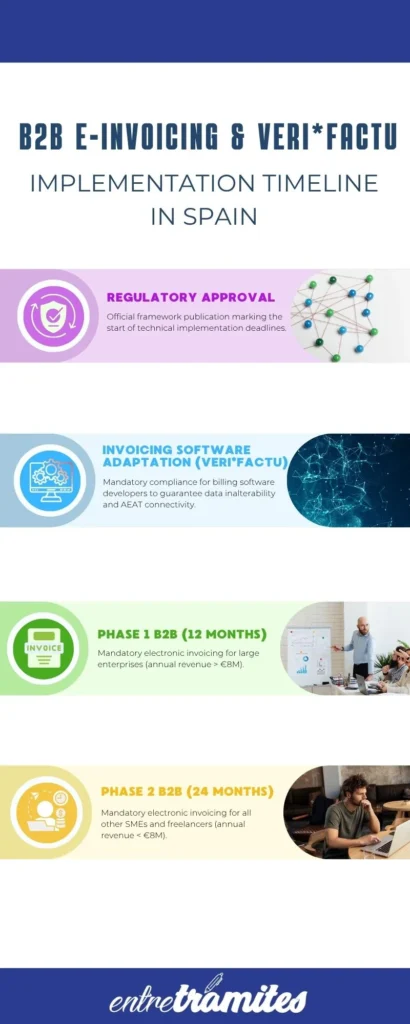
Spain is advancing rapidly in its digitalization requirements. Due to the “Crea y Crece” Law and the Veri*factu regulations rolling out, your billing software must guarantee the traceability and inalterability of invoices. Ensure that your e-commerce platform complies with Spanish e-invoicing standards and can connect directly with the Tax Agency’s systems to avoid compliance issues.
Step 5: Logistics, Shipping, and Payment Gateways
A successful e-commerce in Spain relies heavily on a seamless checkout and fast delivery network.
Payment Gateways
Spanish consumers expect diverse payment methods. Beyond standard credit/debit cards (processed via gateways like Stripe or Redsys), integrating Bizum (a wildly popular mobile payment system in Spain) will significantly increase your conversion rate. Remember, the law explicitly forbids charging customers hidden surcharges for using specific payment methods.
Logistics and Returns
You must outline your shipping policy clearly. According to Spanish consumer protection laws, buyers have a 14-day withdrawal period to return products purchased online without needing to justify their decision. If you fail to state this 14-day limit in your Terms and Conditions, the return window legally extends to 12 months. Partner with reliable local couriers to ensure timely deliveries and hassle-free returns.
Frequently Asked Questions (FAQs)
Do I need to register as a freelancer to run an e-commerce in Spain?
Yes. If you conduct online sales habitually to generate income, you must register as an autónomo (or form a company) with the Tax Agency and Social Security, regardless of how much you earn initially.
How does VAT work if I sell to other EU countries?
For B2C sales across the EU, you charge Spanish VAT until you exceed €10,000 in total cross-border sales per year. Once you cross that threshold, you must charge the VAT rate of the customer’s country.
What happens if I don’t include a Legal Notice on my website?
Failing to clearly identify your business structure, address, and Tax ID (NIF/CIF) violates the LSSI-CE (Spanish E-Commerce Law) and can result in severe financial penalties from the authorities.
Launching an online store requires more than just a good product and a nice design; administrative compliance is the bedrock of your business. By structuring your taxes correctly, adhering to consumer protection laws, and utilizing systems like the OSS scheme, you ensure your project grows sustainably.
If you need personalized assistance, at Entre Trámites we offer management and tax advisory services for freelancers and SMEs. You can contact us through this contact form for us to call you, or if you prefer, you can schedule a free consultation or write to us on WhatsApp.