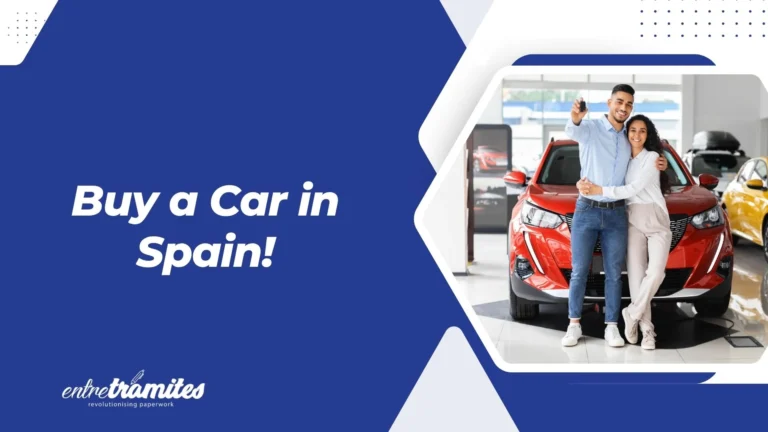
Whether you want to explore the hidden coastal coves of the Costa Brava or simply need a reliable way to commute from your inland village, having your own vehicle offers unmatched freedom. However, for many expats, the idea of buying a car in Spain can feel like stepping into an administrative maze. From deciphering local taxes to figuring out the paperwork required by the traffic authorities, the process is very different from what you might be used to back home.
Do not let the bureaucracy keep you from hitting the road. In 2026, the local administration has clear, standardized procedures. By understanding exactly what documents you need and how the Spanish taxation system works, you can secure your new ride quickly and legally.
Essential requirements for buying a car in spain
Before you even step foot in a dealership or message a private seller online, you need to have your administrative foundation in place. As a foreigner, you cannot simply hand over cash and drive away. You must prove your identity and your local address to the government.
Your Spanish tax number
The most critical document is your NIE (Número de Identidad de Extranjero – Foreigner Identity Number). This unique identification code is mandatory for nearly every financial transaction in the country, including registering a vehicle in your name.
Proof of address
You will also need a valid Empadronamiento. This is a certificate proving you are registered at your local town hall (Ayuntamiento). The traffic authorities require this document to be no older than three months at the time of your vehicle purchase, as it dictates where your annual road taxes will be billed.
Understanding the taxes and fees
The costs associated with getting a vehicle go beyond the sticker price. Depending on whether you are purchasing a brand-new model from a showroom or a second-hand vehicle from a neighbor, your tax obligations will change.
Taxes on new vehicles
When you buy a brand-new car, you are required to pay IVA (Impuesto sobre el Valor Añadido – Value Added Tax), which currently sits at 21%. Additionally, you must pay a registration tax (Impuesto de Matriculación) based on the car’s CO2 emissions. For electric or very low-emission vehicles, this tax can be 0%, whereas high-polluting cars can incur a tax of up to 14.75%.
Taxes on used vehicles
If you are buying a car in Spain from a private individual, you do not pay IVA. Instead, you are liable for the ITP (Impuesto de Transmisiones Patrimoniales – Property Transfer Tax). This regional tax usually ranges between 4% and 8% of the car’s official value (not necessarily the price you paid for it), depending on the Autonomous Community where you live.
The step-by-step transfer process
When purchasing a second-hand car, the official change of ownership takes place at the DGT (Dirección General de Tráfico), which is the national traffic authority.
Using a Gestor to save time
While you can book an appointment and go to the DGT yourself, most expats and locals alike use a Gestor. A Gestor is a specialized Spanish administrative agent who handles paperwork on your behalf. For a modest fee (usually around €50 to €100), they will submit the sales contract, pay the ITP on your behalf, and instantly issue a provisional driving document while your official physical registration paper (Permiso de Circulación) is being processed.
Requesting a background check
Before signing any contract with a private seller, always request an Informe de Vehículo from the DGT. This report will tell you if the car has unpaid fines, embargoes, or if it has been written off in an accident.
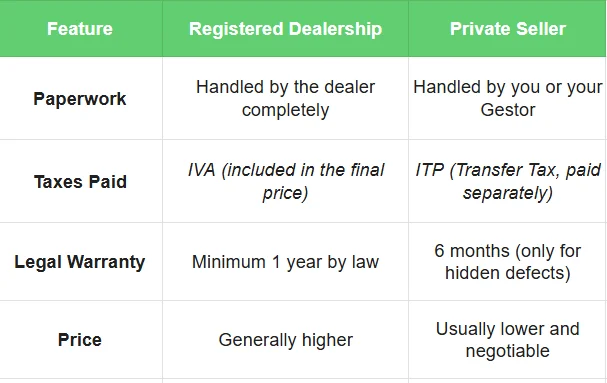
Dealerships vs. Private Sellers: A quick comparison
To help you decide which route is best for your situation, here is a breakdown of what to expect from both options:
Don’t forget the ITV and Insurance
Before you can legally drive your new purchase off the lot or out of the seller’s driveway, two final pieces of the puzzle must be in place. First, your vehicle needs active insurance (Seguro). In Spain, insurance is tied to the car itself, not just the driver, and driving without basic third-party liability coverage carries massive fines.
Second, ensure the car has a valid ITV (Inspección Técnica de Vehículos). This is the mandatory technical safety inspection (similar to an MOT in the UK). New cars do not need an ITV for the first four years, but older vehicles require an inspection every one or two years. A car cannot be legally transferred to a new owner if its ITV is expired.
Getting the keys to your own vehicle unlocks a completely different side of the Spanish lifestyle, allowing you to discover charming villages and remote beaches at your own pace. While the initial paperwork, tax forms, and traffic authority rules might seem intimidating, taking it one step at a time ensures you stay fully compliant. Gather your documents, consider hiring a local professional to handle the heavy lifting, and enjoy the open road with total peace of mind.
Frequently Asked Questions (FAQs)
Can I legally complete the process of buying a car in Spain if I am not a resident?
Yes. You do not need to be a formal legal resident with a residency visa to buy a car. However, you absolutely must have a NIE and a valid Empadronamiento to prove you have a registered address in the country where the vehicle will be domiciled.
Who is responsible for paying the annual road tax when a vehicle is sold?
The local road tax (Sello or IVTM) is always the legal responsibility of whoever owned the vehicle on January 1st of that tax year. If you buy a car in July, the seller should have already paid the tax for that entire year, and you will not have to pay it until the following year.
Do I need a Spanish driver’s license to buy and register a car?
No, the traffic authorities do not check your driver’s license when you register a vehicle in your name. You can own a car with any passport. However, to actually drive it, you must have a valid driver’s license from your home country (along with an International Driving Permit if applicable) or exchange it for a Spanish one if required by your residency status.
If you need personalized assistance, at Entre Trámites we offer management and advisory services on immigration matters. You can contact us through this contact form for us to call you, or if you prefer, you can schedule a free consultation or write to us on WhatsApp.