
Buying a property in the Iberian Peninsula is an incredible milestone, whether it is a sun-drenched apartment in Alicante or a rustic villa in Andalusia. But once the notary signs the deeds and you finally have the keys in your hand, your priority shifts from buying to protecting. Navigating the rules around house insurance in Spain is essential to avoid nasty financial surprises down the road.
The Spanish insurance system has a few unique quirks and legal requirements that often catch foreigners off guard. From mandatory coverage tied to mortgages to state-backed natural disaster funds, knowing exactly what you are paying for will save you time, money, and stress. Let’s break down the bureaucracy so you can secure your Spanish haven with absolute confidence.
Is house insurance in Spain legally mandatory?
The short answer is: it depends on how you bought the property. If you purchased your home in cash, there is no strict legal obligation to insure it. However, leaving your biggest asset completely unprotected is a huge financial risk.
On the other hand, if you took out a Spanish mortgage (Hipoteca), the law requires you to have at least a basic policy that covers fire damage. Historically, Spanish banks would force buyers to use the bank’s own expensive insurance policies to get a good interest rate. Thankfully, current European and Spanish laws strictly prohibit this abusive practice. You are completely free to shop around and buy your house insurance in Spain from any provider, as long as the bank is listed as the beneficiary for the remaining mortgage amount.
Decoding the policy: Building vs. Contents
When you look at a Spanish insurance quote (known as a Seguro de Hogar), you will immediately notice that the coverage is split into two main categories. Getting the valuation right for both is crucial to ensure you are fully covered in the event of a total loss.
Continente (The Building)
This refers to the physical structure of your home—the walls, roof, floors, built-in wardrobes, and fixed plumbing or electrical installations. A common expat mistake is insuring the Continente for the property’s market value. You should only insure it for the rebuild cost (the cost of labor and materials to rebuild the house from scratch), which is usually much lower than the price you paid to buy it.
Contenido (The Contents)
This covers everything inside the house that would fall out if you turned the building upside down. It includes your furniture, appliances, clothing, electronics, and jewelry. Be honest about the value of your possessions; if you insure to get a cheaper premium, the insurance company will apply the “proportional rule” and only pay out a fraction of your claim if disaster strikes.
The Spanish Safety Net: The Consorcio
One of the best features of getting house insurance in Spain is gaining access to the Consorcio de Compensación de Seguros (Insurance Compensation Consortium). This is a government-backed institution that acts as an emergency safety net.
Whenever you pay your private home insurance premium, a tiny fraction of that money goes directly to the Consorcio. In return, if your home is damaged by an “extraordinary risk”—such as earthquakes, tidal waves, or extreme floods (like the severe DANA weather events that have increasingly impacted the Mediterranean coast through 2026)—the government steps in to cover the damages that your private insurer won’t. However, the golden rule applies: the Consorcio will only help you if you have a valid, fully paid private home insurance policy active at the time of the event.
Key coverages you shouldn’t skip
Beyond the basic fire and theft protection, a comprehensive policy should protect you from the everyday realities of living in Spain.
Responsabilidad Civil (Third-Party Liability)
This is arguably the most important element of your policy. If a pipe bursts in your bathroom and floods the apartment below you, Spanish civil law dictates that you are financially responsible for the repairs to your neighbor’s property. Responsabilidad Civil covers these costs, as well as legal fees if you are sued.
Protección contra Okupas (Squatter Protection)
A major concern for many expats with second homes is the risk of squatters (okupas). Modern, high-quality policies in 2026 now include specific legal defense coverages. If someone illegally occupies your home, the insurance will cover the legal fees, court costs, and locksmith charges required to evict them, and sometimes even compensate you for damages to the property.
Policy Comparison Overview
To help you decide what level of coverage suits your needs, here is a quick breakdown of typical policy tiers in Spain:
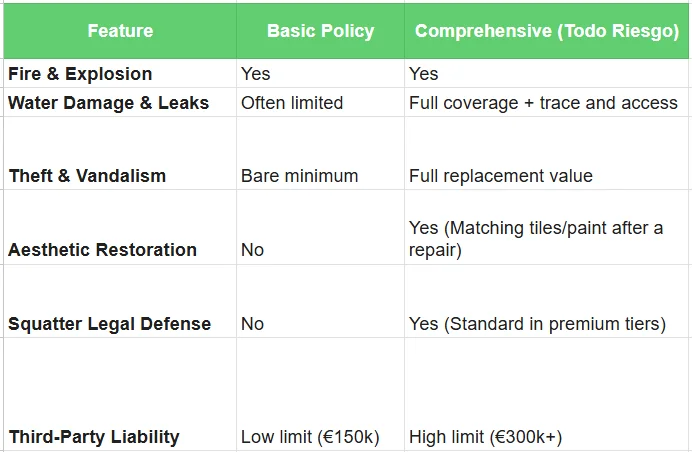
Setting up your policy is straightforward. Start by calculating your exact rebuild and contents value. Then, reach out to an English-speaking insurance broker. Brokers are highly recommended in Spain because they negotiate with multiple companies on your behalf and handle the complex claims process directly with the loss adjusters. Ensure you read the fine print regarding security requirements, as some policies demand that you have specific locks or alarms active when the house is empty.
For deeper insights into consumer rights and insurance regulations, checking the official site of the Dirección General de Seguros y Fondos de Pensiones is a great starting point. By doing your homework, you guarantee that your Spanish dream home remains a source of joy, safely shielded from the unexpected.
Frequently Asked Questions (FAQs)
Can I switch my house insurance if I already bought one through my Spanish bank?
Yes. By law, you can cancel your bank-linked home insurance and switch to a different provider. However, you must notify the bank in writing at least 30 days before the annual renewal date of the policy. Keep in mind that if your mortgage interest rate was legally subsidized by holding the bank’s insurance, canceling it might slightly increase your monthly mortgage payments.
Do I need a special policy if my Spanish property is a holiday home?
Yes. You must inform the insurance company if the property is a Segunda Residencia (second home) and left empty for long periods. Standard policies often assume the property is occupied daily. If a water leak occurs while the house is empty for months and you haven’t declared it as a holiday home, the insurer may reject your claim.
Will my insurance cover me if I rent my Spanish house to tourists?
A standard residential policy will not cover damages caused by short-term paying guests. If you plan to list your property on platforms like Airbnb, you must upgrade your policy to include specific coverage for tourist rentals. This ensures your civil liability is extended to protect both your guests and your property during their stay.
If you need personalized assistance, at Entre Trámites we offer management and tax advisory services for freelancers and SMEs. You can contact us through this contact form for us to call you, or if you prefer, you can schedule a free consultation or write to us on WhatsApp.