If you are an expat living in the Iberian Peninsula or an investor looking to transfer assets to your loved ones, understanding the local tax system is crucial. Deciding to give a financial boost to your children or transferring a property while you are still alive is a generous move, but it requires careful planning. Unlike in many other countries, the gift tax in Spain comes with a unique set of bureaucratic rules and hidden fiscal traps that can catch both the giver and the receiver off guard.
Navigating this process doesn’t have to be a nightmare. By understanding the critical role of a public notary and how gifting impacts your annual income tax return, you can transfer your wealth smoothly and legally, avoiding hefty fines from the Spanish tax authorities.
How the gift tax in Spain is structured
In Spain, giving away assets—whether it is cash, real estate, or shares—triggers the Impuesto de Sucesiones y Donaciones (Inheritance and Gift Tax). This tax is progressive, meaning the more you give, the higher the tax rate applied to the recipient. However, the most critical aspect of this tax is that it is heavily decentralized.
Every Comunidad Autónoma (Autonomous Region) in Spain has the power to set its own tax rates, allowances, and deductions (known as bonificaciones). For instance, regions like Madrid, Andalusia, and the Valencian Community offer massive deductions—sometimes up to 99%—when gifts are made between close family members, such as parents to children.
Determining the applicable region
If you are gifting cash, the tax rules of the region where the recipient has lived for the majority of the past five years will apply. If you are gifting real estate, the rules of the region where the property is physically located will dictate the tax, regardless of where the recipient lives.
The Golden Rule: Why a Notary is Mandatory
A common misconception among expats is that executing a simple bank transfer is enough to gift money to a relative. While the bank transfer is physically easy, doing only this will automatically disqualify the recipient from accessing those generous regional tax deductions.
To legally benefit from the regional bonificaciones, the gift must be formalized through an Escritura Pública (Public Deed) signed before a Notario (Notary Public). A Notary is a legal professional authorized by the government to certify contracts and deeds.
The origin of funds requirement
When you sit down with the Notary to sign the public deed for a cash donation, Spanish law strictly requires you to state the exact origin of the funds. You must provide bank statements proving where the money came from and the exact account it is going into. If this public deed is not signed at the time of the donation—or if the origin of the funds is not clearly justified in the document—the recipient will be forced to pay the full, unbonified gift tax rate. In 2026, tax authorities are increasingly cross-referencing bank data, making this formal step more vital than ever.
The Hidden Trap: How Gifting Affects the Donor’s IRPF
This is where the gift tax in Spain differs drastically from inheritance, and where many expats make costly mistakes. When you gift an asset, you might assume that only the person receiving the gift has to pay taxes. Unfortunately, Hacienda (the Spanish Tax Agency) sees things differently.
When you gift property, shares, or investment funds, you are giving away an asset that has likely grown in value since you originally acquired it. In the eyes of the tax office, this transfer triggers a ganancia patrimonial (capital gain) for the donor.
As the donor, you must declare this “fictitious” profit in your IRPF (Personal Income Tax, Impuesto sobre la Renta de las Personas Físicas). For example, if you bought a Spanish villa for €150,000 and gift it to your daughter when its market value is €350,000, Hacienda calculates that you have made a capital gain of €200,000. You will have to pay income tax on that €200,000 gain, even though you never actually received any money from the transfer.
The inheritance exception
This capital gains trap does not happen with inheritances. When assets are passed down after death, the capital gain is wiped out—a concept colloquially known as the “dead man’s plusvalía”. Therefore, it is highly recommended to consult a tax advisor to calculate whether it is cheaper to gift a property now or leave it in your will.
Gifting Cash vs. Gifting Real Estate
To make the technicalities easier to digest, here is a quick breakdown of how different types of gifts trigger different tax obligations in Spain.
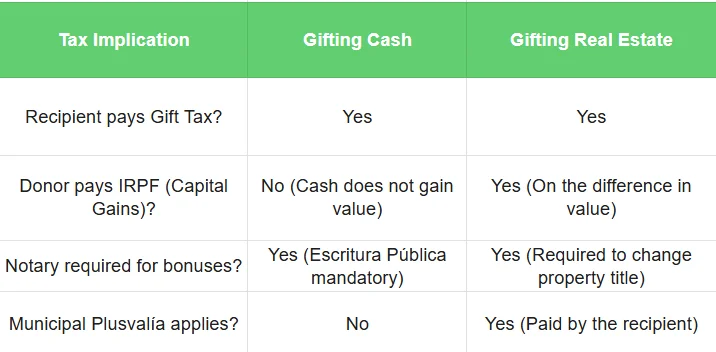
Step-by-Step: Processing your gift tax in Spain
If you are ready to proceed with a donation, following the correct administrative steps will save you from penalties and surcharges.
Step 1: Prepare the documentation
Gather your identification, bank certificates showing the transfer of funds, or the original title deeds if you are gifting a property.
Step 2: Sign the Public Deed
Book an appointment with a local Notary. Both the donor and the recipient (or their legal representatives) must be present to sign the Escritura Pública. Ensure the Notary explicitly states the origin of the funds if cash is involved.
Step 3: Submit Form 651
The recipient has exactly 30 working days from the day the gift is received (or the deed is signed) to file and pay the gift tax in Spain using Form 651 (Modelo 651). This is submitted to the regional tax office, not the national one. Even if the regional deductions bring your tax bill down to zero, you are still legally required to file the form to declare the operation.
Dealing with the Spanish bureaucracy can feel overwhelming, but taking the time to formalize your donations before a Notary and planning for your annual income tax return will protect your family’s wealth. Always rely on official sources like the Spanish Tax Agency for up-to-date forms, and remember that doing things by the book is the absolute best way to enjoy peace of mind in your new Spanish life.
Frequently Asked Questions (FAQs)
Do non-residents have to pay the gift tax in Spain?
Yes. If the recipient is a non-resident but receives real estate located in Spain, or if a non-resident receives cash from a Spanish resident, the tax must be paid. However, thanks to EU regulations, non-residents can now apply the same regional tax bonuses as residents.
Can I give small cash gifts without going to a Notary?
Technically, all gifts are subject to tax. For small, everyday amounts (like a birthday present), the tax office generally does not intervene. However, for larger amounts (typically anything over €3,000, which banks automatically flag), you must use a Notary to legally claim any regional tax reductions.
Does the recipient pay income tax on the gifted money?
No. The recipient only pays the Gift Tax. The money or property received does not need to be added to the recipient’s general income base for their annual IRPF declaration, as it has already been taxed under the gift regulations.
If you need personalized assistance, at Entre Trámites we offer management and tax advisory services for freelancers and SMEs. You can contact us through this contact form for us to call you, or if you prefer, you can schedule a free consultation or write to us on WhatsApp.