
If you are a non-EU citizen living in Spain, securing your initial visa was likely a major milestone. However, to continue your legal stay, you will eventually face the Residence renewal process. Unlike the initial application, this procedure is generally faster and entirely handled from within Spain. Still, it requires meticulous document preparation and strict adherence to government deadlines.
Failing to comply with the rules for your Residence renewal can lead to an irregular administrative situation, potential fines, and even a deportation order. In this comprehensive guide, we provide a detailed breakdown of the requirements, the exact documents you need in 2026, and essential tips to ensure your application is approved smoothly.
Key Requirements and Documents for your Residence renewal
The fundamental requirement for any Residence renewal is proving that you have maintained the original legal conditions that allowed your initial permit to be granted. The Spanish Foreigners Office (Oficina de Extranjería) will strictly evaluate your file based on the permit you currently hold.
Essential Documents to Prepare
To submit a complete file, you will need to gather several mandatory documents. While some permits require extra evidence, the standard documentation includes:
- Application Form: The official EX form corresponding to your residency type (for example, EX-01 for the Non-Lucrative Visa, EX-03 for the standard Work Permit). It must be correctly completed and physically or digitally signed.
- Passport: A full, scanned copy of your valid passport. This means copying every single page, including the blank ones, to prove your travel history.
- TIE Copy: A clear copy of both the front and back sides of your current Foreigner Identity Card (TIE).
- Updated Padrón: A municipal registration certificate (certificado de empadronamiento) issued within the last three months, proving you still live at your registered address in Spain.
- Proof of Fee Payment: You must present the stamped receipt proving the payment of the administrative processing fee via Form 790, Code 052.
Understanding the Administrative Fees
In 2026, the Spanish government updated the administrative fees for processing immigration files. The Form 790, Code 052 is required just to instruct the application, and the exact cost depends entirely on your current status.
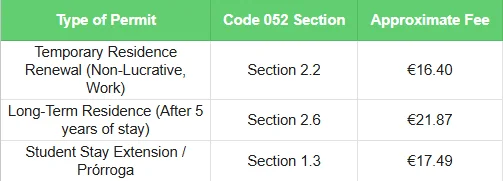
Keep in mind that once your renewal is approved, you will need to pay a second, separate fee (Form 790, Code 012) directly to the National Police to physically print your new plastic TIE card.
Proving Your Financial Means
This is typically the most scrutinized part of the process. If you hold a Non-Lucrative Visa, the requirement is based on the IPREM indicator. Because your initial card was valid for just one year, you proved one year’s worth of funds. However, the renewed card is valid for two years, meaning you must demonstrate double the initial amount—either in liquid bank savings or guaranteed passive income.
For those renewing an employee work permit (Cuenta Ajena), if you have not worked a full six months per year, you must justify the periods of unemployment. You can do this by proving you were officially registered as a job seeker with the SEPE and that you have a new, valid job offer at the time of your renewal.
If you are renewing a self-employed work permit (Cuenta Propia), you must demonstrate that your business or freelance activity remains active and profitable. You will need to submit your recent quarterly tax returns (IVA and IRPF), prove that you have no outstanding debts with the Tax Agency (Hacienda) or Social Security, and show that the income generated is sufficient to support yourself.
Strict Deadlines and the Application Process
When it comes to the legal timeframe, the Spanish General Immigration Law is very clear. Missing your window can complicate your legal status significantly.
The Submission Period
You can legally submit your application within the 60 calendar days immediately preceding the expiration date printed on your current TIE card.
The Grace Period and Penalties
Regulations do allow a grace period of 90 calendar days following the expiry date to submit your file. However, using this grace period is highly discouraged, as the administration can initiate a sanctioning procedure and impose a proportional fine for the delay. Submitting your file on time, during the first 60 days, automatically extends the legal validity of your current card until a formal resolution is issued, allowing you to continue working and living normally.
The Rule of Administrative Silence
The Administration has a legal maximum of three months to resolve your application. For most standard renewals, if this time passes without any formal notification, the Residence renewal is legally considered approved by positive administrative silence (silencio administrativo positivo).
Step-by-Step Procedure
- Gather documents: Review all paperwork, ensuring financial proofs are robust and recent.
- Pay the fee: Pay the Form 790 Code 052 fee online or by bringing the printed form to a collaborating Spanish bank.
- Submit electronically: Submit your application through the government’s Mercurio Platform using a Digital Certificate or Cl@ve system. Submitting physically at the Oficina de Extranjería is possible but heavily restricted, as securing a prior appointment (cita previa) can take weeks. The Mercurio platform allows 24/7 submission and provides an immediate digital receipt (resguardo), which serves as your legal proof of extension.
Practical Tips for a Successful Outcome
Traveling During the Renewal Process
A very common question among expats is whether they can leave Spain while their renewal is processing. Since your expired card is no longer valid for crossing Schengen borders, traveling internationally carries a risk. If you absolutely must travel to your home country while waiting for your resolution, you must apply for a Return Authorization (Autorización de Regreso) at your local police station. This document permits you to leave and re-enter Spain directly within a 90-day window, but it is strictly for direct flights to and from Spain and does not allow you to transit through other European Schengen countries.
To avoid requests for additional documents (requerimientos) which will freeze and delay your approval, keep these professional tips in mind:
Start the process early. Gather your financial documents, apostilles (if needed), and local
certificates weeks before your 60-day window opens. Do not wait until the last minute.
Check for any pending penalties. A renewal application will almost certainly be denied if you have committed serious crimes in Spain or have outstanding administrative fines (such as unpaid traffic tickets or tax debts).
Report any life changes immediately. If you have changed your address, gotten married, or switched employers, make sure the Foreigners Office is aware, as discrepancies between their database and your application can trigger a denial.
Frequently Asked Questions (FAQs)
Can I work while my Residence renewal is being processed?
Yes. As long as you submit your renewal application within the legal timeframe (60 days before or up to 90 days after expiration), the rights granted by your previous residence card are automatically extended. This means you can legally continue to work, live, and operate in Spain until the administration issues a final resolution on your case.
What should I do if my renewal is denied?
If your renewal is denied, you will receive a formal notification explaining the reasons for the refusal. You generally have exactly one month to file an administrative appeal (recurso de reposición) against the decision. It is highly recommended to hire an immigration lawyer to draft this appeal, as you must provide solid legal arguments and additional documentation to overturn the denial.
How do I download and pay the Form 790 Code 052 fee?
You must download the form directly from the official web portal of the Spanish Public Administration. You cannot use photocopies of another person’s form because each downloaded PDF contains a unique barcode. Once you fill out your personal details online, print the document and take it to any major Spanish bank to pay in cash or directly from your account.
Navigating Spanish bureaucracy can be complex, and any mistake can jeopardize your legal status. Ensuring you have the right documents and submitting them through the correct electronic channels saves you time and avoids unnecessary stress. If you have doubts about your specific situation or lack a Digital Certificate, it is always best to seek professional advice to secure your future in Spain.
At Entre Trámites we offer management and tax advisory services for freelancers and SMEs. You can contact us through this contact form for us to call you, or if you prefer, you can schedule a free consultation or write to us on WhatsApp.