Discovering that you have an unpaid obligation with the Spanish Tax Agency (Agencia Tributaria or Hacienda) can feel overwhelming. Whether you are an expatriate working as a freelancer (autónomo), managing a local business, or living as a tax resident, dealing with public liabilities requires prompt and informed action. Failing to address these obligations can quickly lead to late payment surcharges, accruing interest, or even the seizure of bank accounts.
Understanding how the system works allows you to protect your solvency and maintain full compliance. In 2026, the Spanish administration offers several legal pathways to handle outstanding liabilities efficiently. Below is a comprehensive guide on why these obligations arise, how to check your status, and five practical strategies to settle your tax debt in Spain.
Common Causes of an Unpaid tax debt in Spain
Public liabilities rarely result from intentional non-payment. More often, they stem from accounting oversights, delayed client payments, or simple procedural misunderstandings. The most frequent sources include:
Value Added Tax (VAT / IVA): Self-employed individuals and corporate entities must declare quarterly VAT via Modelo 303. If clients delay paying their invoices, you may still owe VAT to Hacienda for revenue you have not yet collected.
Personal Income Tax (IRPF): Miscalculating quarterly advance payments (Modelo 130 or 131) or making errors on your annual income tax return (Declaración de la Renta) can result in an unexpected balance due.
Corporate Income Tax: Companies that make calculation errors on their annual return (Modelo 200) or misapply deductions can face subsequent tax adjustments.
Social Security Contributions: Delays or errors in paying monthly autonomous worker fees (cuota de autónomo) or employee contributions to the Tesoreria General de la Seguridad Social (TGSS) generate separate public liabilities that accumulate interest rapidly.
Local Municipal Taxes: Unpaid property taxes (IBI), mechanical traction taxes (IVTM), municipal capital gains (Plusvalía Municipal), or traffic fines issued by the Dirección General de Tráfico (DGT) also create enforceable public debts.
How to Check Your Standing with the Tax Agency
If you suspect you have an outstanding liability, you should verify your status immediately rather than waiting for an official notification. Ignoring administrative notices (notificaciones electrónicas) does not stop the legal clock.
You can check your status online through the Electronic Headquarters (Sede Electrónica) of the Agencia Tributaria. Access the section titled “Pay, defer, and consult debts” (Pagar, aplazar y consultar deudas). To log in, you will need one of the following digital identification tools:
- An active Digital Certificate (Certificado Digital)
- A registered Cl@ve PIN system access
- An Electronic DNI (DNIe)
Once logged in, you can view your pending items, review enforcement stages, and download payment forms directly.
5 Practical Strategies to Settle Your tax debt in Spain
When managing a tax debt in Spain, choosing the right mechanism depends on your immediate cash flow and overall financial health.
1. Request a Payment Deferral or Installment Plan (Aplazamiento o Fraccionamiento)
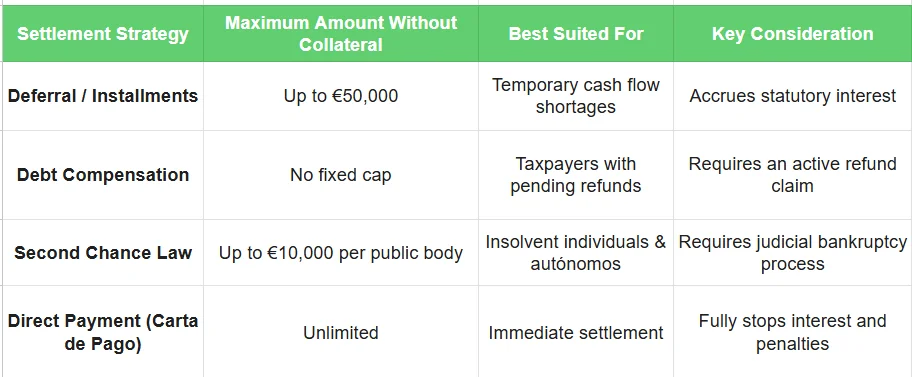
If you lack the liquidity to settle the amount at once, you can formally request a deferral or break the balance into monthly installments. Under current regulations, taxpayers can defer liabilities up to €50,000 without providing collateral or bank guarantees (sin garantías). You can propose a payment schedule that fits your cash flow, though Hacienda will apply the statutory late payment interest rate to the deferred amount.
2. Utilize Automatic Debt Compensation (Compensación de deudas)
If you owe money for one tax (such as quarterly VAT) but are owed a refund on another (such as your annual IRPF return), you can request a compensation. Hacienda can automatically offset your liability against your approved refund, settling your balance without requiring an out-of-pocket cash transfer.
3. Apply for Partial Relief Under the Second Chance Law
If you are facing severe insolvency as an individual or freelancer, you may qualify for the Second Chance Law (Ley de Segunda Oportunidad). Under Spain’s framework, insolvent debtors undergoing judicial debt restructuring can achieve a partial discharge of public debt—up to €10,000 with the Tax Agency and up to €10,000 with the Social Security authorities.
4. Obtain an Official Payment Document (Carta de Pago)
If you have the necessary funds available, the fastest way to clear your balance is to generate an official payment document (carta de pago) from the Tax Agency website. You can complete the payment immediately via online banking, debit card, or at an authorized banking entity.
5. Secure Commercial Financing to Prevent Enforcement
If you do not qualify for an administrative deferral, securing a commercial bank loan with favorable interest rates may be preferable to entering execution proceedings (vía de apremio). Enforcement proceedings carry automatic surcharges ranging from 5% to 20%, plus potential bank account seizures.
Which Tax Liabilities Can Be Deferred?
Not all tax obligations are eligible for installment plans. Understanding these boundaries helps prevent rejected applications:
Non-deferrable obligations: Taxes withheld from third parties—such as employee income tax withholdings (Modelo 111) or property rental withholdings (Modelo 115)—cannot be deferred, as you are acting as a collection agent for the state. Corporate tax fractional payments (Modelo 202) are also non-deferrable by default.
Deferrable obligations: Personal income tax payments for freelancers (Modelo 130 and 131), annual corporate tax balances (Modelo 200), quarterly VAT settlements (Modelo 303), and standard personal income tax returns (Modelo 100) can generally be deferred or split into installments.
Settling your tax debt in Spain through official channels ensures peace of mind and keeps your professional activities running smoothly without administrative friction.
Frequently Asked Questions (FAQs)
How do I find out if I have a tax debt in Spain?
You can check your tax status online by accessing the Electronic Headquarters of the Spanish Tax Agency (Agencia Tributaria) using a Digital Certificate, Cl@ve PIN, or Electronic DNI.
Can I pay my tax debt in Spain in installments?
Yes. You can request a payment deferral or installment plan (fraccionamiento) for debts up to €50,000 without providing collateral or bank guarantees.
What happens if I ignore a tax debt in Spain?
Ignoring a public debt triggers enforcement proceedings (vía de apremio), which add automatic surcharges of 5% to 20%, late interest, and can result in the seizure of bank accounts or assets.
Navigating Spanish tax procedures demands accuracy and attention to strict deadlines. If you need personalized assistance, at Entre Trámites we offer management and tax advisory services for freelancers and SMEs. You can contact us through this contact form for us to call you, or if you prefer, you can schedule a free consultation or write to us on WhatsApp.