Last updated: November 2026 – Content reviewed according to current regulations.
The “Crea y Crece” Law makes electronic invoicing legally mandatory for all B2B transactions to combat late payments. You must use certified digital software to issue structured invoices by April 2025 (for large companies) or April 2026 (for SMEs and freelancers).
Who it applies to: All freelancers, SMEs, and large corporations carrying out business-to-business (B2B) commercial operations within Spanish territory.
When it does not apply: B2C (Business-to-Consumer) transactions where the end customer is an individual, or operations involving foreign entities not established in Spain.
What the “Crea y Crece” Law Demands for E-invoicing in Spain
Law 18/2022, officially known as the Law for the Creation and Growth of Businesses (“Crea y Crece”), introduces strict technical rules to ensure financial transparency. While dealing with Spanish Public Administrations already required digital invoices since 2015, this legislation expands the mandate strictly to the private sector.
You can no longer rely on simple PDFs or Word documents for your billing. To comply with the e-invoicing in Spain regulations, your documents must meet specific parameters approved by the Tax Agency (Agencia Tributaria).
Mandatory Requirements for Your Digital Invoices
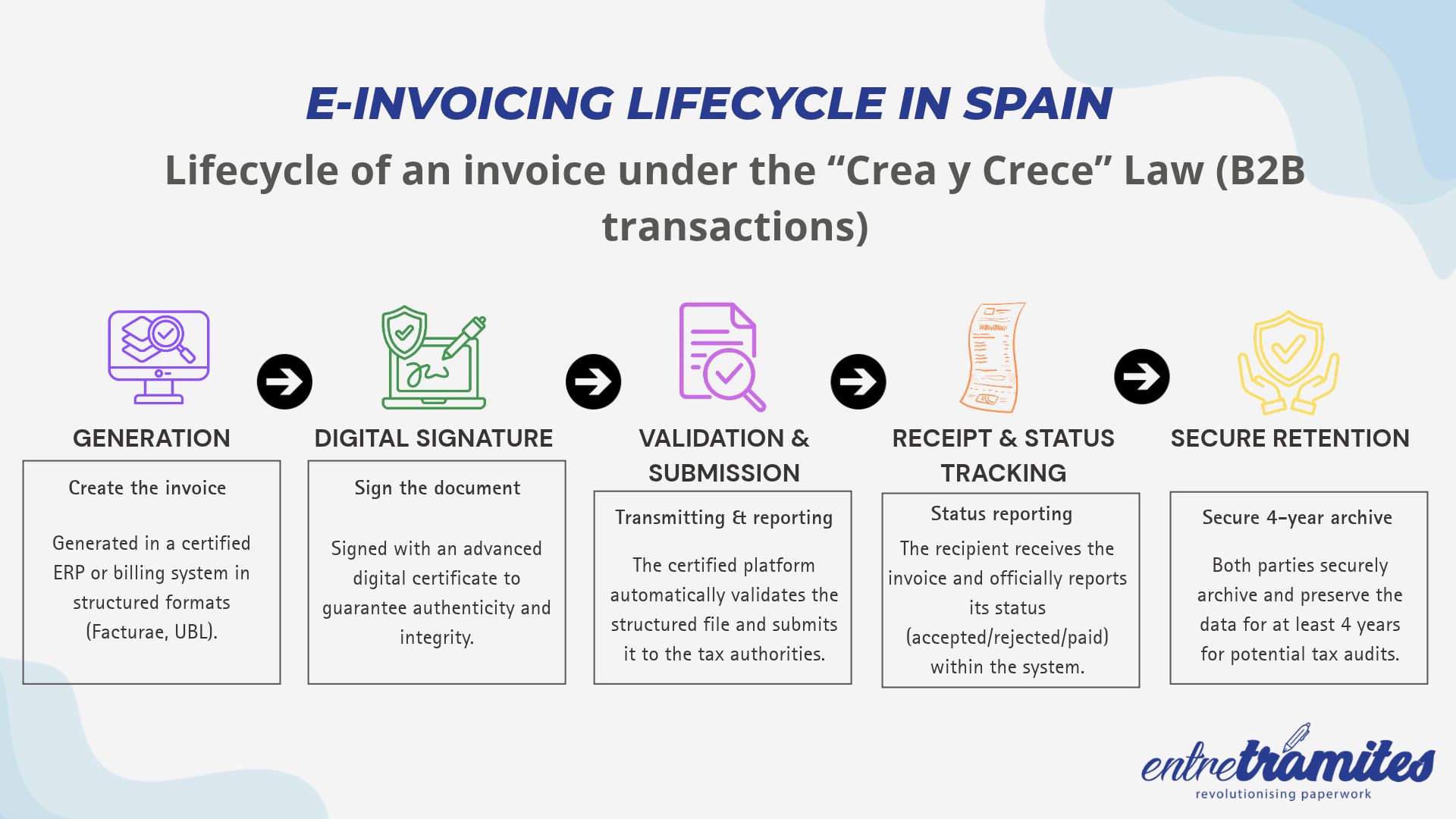
To avoid penalties and ensure your invoices are legally binding, your chosen billing software must generate files that fulfill these criteria:
| Requirement | Technical Detail |
| Structured Format | Files must be readable by accounting systems (e.g., Facturae, UBL, CII, or EDIFACT). A standard PDF is legally invalid. |
| Digital Signature | Must include an advanced electronic signature or digital certificate to guarantee authenticity and data integrity. |
| Status Reporting | The software must allow the recipient to report the invoice status (accepted, paid, or rejected) with exact dates. |
| Data Retention | You must securely store and guarantee access to all electronic invoices for a minimum of 4 years for potential tax inspections. |
Official Implementation Deadlines for E-invoicing in Spain
The obligation to issue electronic invoices rolls out progressively based on your company’s annual billing volume. The specific technical regulations were officially approved in April 2024, setting the definitive countdown for implementation.
| Annual Turnover | Legal Implementation Deadline | Consequence of Non-Compliance |
| Over €8 Million | April 2025 (1 year post-regulation). | Economic sanctions, exclusion from public tenders, inability to legally collect debts. |
| Under €8 Million | April 2026 (2 years post-regulation). | Same as above. |
Note: Even if your deadline is set for 2026, implementing the changes early helps you streamline your accounting processes and allows you to apply for current state subsidies before funds run out.
How to Adapt Your Business and Avoid Penalties
Choosing the right certified software is the most critical step to successfully implement e-invoicing in Spain. Your provider must guarantee complete integration with the Tax Agency’s requirements and your existing ERP.
Steps to Transition Successfully
- Audit your current system: Verify if your accounting software supports structured formats (Facturae/UBL) and mandatory status reporting.
- Apply for funding: Freelancers and SMEs can utilize the government’s Kit Digital program to subsidize this technological transition, securing grants of up to €12,000 for approved digital solutions.
- Train your team: Ensure your administration department understands how to track the status of received invoices and properly manage corporate digital certificates.
The e-invoicing in Spain mandate fundamentally changes how you manage cash flow and tax reporting. By eliminating manual data entry and enforcing strict payment tracking, the government aims to severely limit the late payments that historically damage SME liquidity. Adapting early ensures you retain your B2B clients without risking operational halts or compliance fines.
Frequently Asked Questions (FAQs)
When do I have to start using e-invoicing if I’m a freelancer in Spain?
If your annual turnover is less than 8 million euros, you must start issuing electronic invoices by April 2026. Companies billing over 8 million euros must comply by April 2025.
Can I continue to use PDFs as electronic invoices?
No. Under the “Crea y Crece” Law, simple PDFs are no longer legally valid for B2B transactions. You must use a structured format like Facturae, UBL, or CII, secured with an advanced electronic signature.
What happens if I don’t comply with the e-invoicing obligation in Spain?
Failing to implement the mandatory system can result in severe economic sanctions (fines of up to €10,000). It will also prevent you from legally enforcing invoice collections and exclude you from public tenders.
Transitioning to digital billing is no longer optional for businesses operating in Spanish territory. Securing certified software early not only protects you from severe financial penalties but also drastically improves your liquidity by enforcing transparent payment terms with your clients.
If you need personalized assistance, at Entre Trámites we offer management and tax advisory services for freelancers and SMEs. You can contact us through this contact form for us to call you, or if you prefer, you can schedule a free consultation or write to us on WhatsApp.