Last updated: October 2026 – Content reviewed according to current regulations.
The internationalization of SMEs and self-employed consists of expanding a business’s operations beyond its domestic borders to capture global demand, access foreign supply chains, or establish international partnerships. In Spain, this process is strongly supported by public institutions to reduce corporate dependency on local consumption and increase export-driven revenue.
Who it applies to: Registered freelancers (autónomos), micro-enterprises, and SMEs in Spain that possess a validated commercial model and want to export physical goods, offer cross-border digital services, or open branches abroad.
When it does not apply: Businesses focused entirely on localized, in-person services within Spain (such as local hospitality or neighborhood retail) that lack the infrastructure, intent, or digital channels to serve foreign clients.
Strategic Advantages of the Internationalization of SMEs and Self-Employed
Expanding operations into foreign markets fundamentally shifts a company’s risk profile and growth trajectory. Relying solely on the Spanish domestic market limits your revenue potential and heavily exposes the business to localized economic downturns.
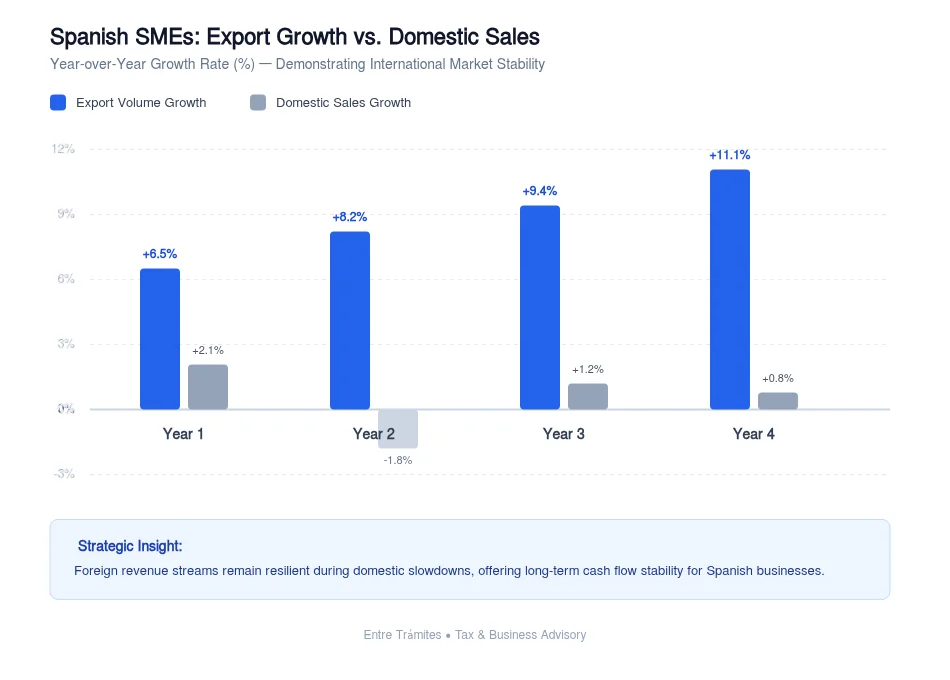
By executing a cross-border strategy, Spanish companies benefit from strict risk diversification. If domestic consumption drops, foreign sales streams provide essential financial stability. Additionally, entering markets with higher purchasing power or differing competitive landscapes allows businesses to optimize pricing strategies and achieve economies of scale, directly lowering the unit cost of production.
The internationalization of SMEs and self-employed also acts as a catalyst for innovation. Competing internationally forces Spanish entities to upgrade technological systems, adopt advanced marketing tools, and comply with strict international quality standards, thereby improving the overall competitiveness of the firm even within its home country.
Financial Grants and Public Support Programs
As of 2026, the Spanish government, through the Ministry of Industry, Trade, and Tourism, actively funds the internationalization of SMEs and self-employed. Accessing these official programs drastically reduces the initial financial burden of market entry, feasibility studies, and international marketing.
- ICEX Next Program: Designed specifically for Spanish SMEs wishing to grow internationally, ICEX Next provides specialized advisory services and financial co-funding. The program co-finances 60% of eligible expenses, providing up to €24,000 in non-refundable grants for international business plans, foreign digital marketing, and participation in global trade fairs.
- ENISA Funding: The National Innovation Enterprise (ENISA) offers participative loans tailored to innovative SMEs and startups scaling their operations. They do not require personal guarantees, basing the funding entirely on the viability and financial plan of the business model, which can be used to fund international expansion.
- ICO International Lines: The Official Credit Institute (ICO) provides credit lines mediated through commercial banks. These lines offer liquidity to freelancers and SMEs to finance the production of goods intended for export, or to cover the costs of establishing commercial networks outside Spain.
- Digital Kit (Kit Digital): Managed by Acelera Pyme / Red.es, this program issues non-refundable digitalization vouchers. Depending on business size, grants range from €3,000 for micro-enterprises and freelancers up to €12,000 for SMEs (and up to €29,000 for larger business tiers). Companies frequently utilize these vouchers to establish multilingual e-commerce platforms, integrate cross-border payment systems, and execute international SEO strategies.
Taxation Rules for Cross-Border Operations
Navigating cross-border tax compliance is the most complex administrative hurdle during the internationalization of SMEs and self-employed. Selling goods or services outside Spain alters how you apply Value Added Tax (VAT) and report income to the Spanish Tax Agency (AEAT).
For business operations within the European Union, Spanish entities must register in the Registry of Intra-Community Operators (ROI) via Form 036. Once approved, you receive a VIES-validated VAT number, allowing you to issue B2B invoices to other EU companies applying a 0% VAT rate under the reverse charge mechanism.
For Business-to-Consumer (B2C) sales across the EU, if your cross-border sales exceed the €10,000 annual threshold, you must charge the specific destination country’s VAT rate. To prevent the administrative burden of registering in every single member state, the One-Stop Shop (OSS) system allows Spanish SMEs to file a single quarterly return declaring all European VAT collected.
When exporting goods to non-EU countries (such as the United States or the UK), the sales are exempt from Spanish VAT as exports. However, they are strictly subject to customs declarations (DUA) and the specific import tariffs of the destination nation.
Structured Steps for Successful Expansion
Executing the internationalization of SMEs and self-employed requires strict operational discipline and thorough planning. Avoid launching into foreign territories without validating your legal, financial, and logistical capabilities beforehand. Using a methodical approach minimizes costly errors and regulatory fines. Rely on the following structured checklist to accurately prepare your entity for seamless foreign operations:
| Phase | Action Required | Key Deliverables |
| 1. Market Analysis | Evaluate target market demand, local competition, and cultural barriers. | Viability study, pricing strategy, and identified distribution channels. |
| 2. Legal & Tax Setup | Ensure compliance with international taxation and intellectual property laws. | ROI registration (Form 036), trademark registration, and OSS setup. |
| 3. Financial Planning | Secure funding for international marketing, logistics, and legal consulting. | Approval of ICEX Next grant, localized budget allocation, and foreign exchange risk plan. |
| 4. Digital Adaptation | Optimize digital sales channels for the target audience. | Multilingual website, international SEO setup, and localized payment gateways. |
| 5. Logistics Network | Establish a reliable supply chain for cross-border delivery and returns. | Partnerships with international couriers and clear return policies defined. |
Monitoring and Adapting Your Strategy
The final pillar of the internationalization of SMEs and self-employed involves continuous monitoring and adaptation. International markets remain highly volatile due to currency fluctuations, changing consumer behaviors, and regulatory shifts. Establish Key Performance Indicators (KPIs) specific to your foreign operations, such as customer acquisition cost per country, cross-border shipping times, and international return rates. Engaging external legal and fiscal consultants specialized in international trade ensures that your business can pivot swiftly to comply with foreign laws without compromising the profitability of your domestic operations.
Frequently Asked Questions (FAQs)
How does VAT work during the internationalization of SMEs and self-employed?
If you sell B2B within the EU and are registered in the ROI, transactions carry a 0% VAT under the reverse charge mechanism. For B2C sales in the EU exceeding €10,000 annually, you must charge the destination country’s VAT through the OSS scheme. Non-EU exports are exempt from Spanish VAT but require customs declarations.
What financial grants support the internationalization of SMEs and self-employed?
Programs like ICEX Next offer co-funding of up to €24,000 for international marketing and planning. Additionally, ENISA provides participative loans without personal guarantees, while the Digital Kit (Kit Digital) offers grant vouchers ranging from €3,000 up to €29,000 depending on company size to help establish cross-border e-commerce platforms and digital infrastructure.
What is the biggest risk in the internationalization of SMEs and self-employed?
The most significant risk is failing to adapt to local tax regulations and cultural differences. Without prior market research and a properly registered VIES VAT number for EU sales, businesses face severe tax penalties and back-tax assessments. For non-EU exports, failing to comply with customs documentation (such as EORI registration) can lead to costly supply chain delays at customs borders.
Taking your business beyond Spanish borders is a transformative decision that guarantees long-term sustainability. While the administrative, logistical, and fiscal requirements may seem daunting initially, leveraging available public grants and strategic planning minimizes your exposure to risk. By ensuring flawless tax compliance and utilizing the proper digital tools, your venture will be fully equipped to capture international demand and thrive in the global marketplace.
If you need personalized assistance, at Entre Trámites we offer management and tax advisory services for freelancers and SMEs. You can contact us through this contact form for us to call you, or if you prefer, you can schedule a free consultation or write to us on WhatsApp.