Are you a foreign company looking to hire top talent in Madrid, Barcelona, or anywhere else on the Iberian Peninsula without the headache of setting up a local corporate entity? You might be considering an employer of record in Spain. While this is a highly popular and efficient strategy for global expansion, the Spanish legal framework has specific quirks that can catch international businesses off guard.
If you are an expat looking to be hired by a foreign company, or a foreign enterprise navigating this process in 2026, understanding the boundaries between legal compliance and labor violations is crucial. This comprehensive guide walks you through everything you need to know to safely use an employer of record in Spain, ensuring both your business operations and your new hires are legally protected.
What Exactly is an Employer of Record?
An Employer of Record (EOR) is a third-party organization that becomes the legal, formal employer of your Spanish workforce. Instead of your company spending months and thousands of euros incorporating a local subsidiary, the EOR hires the employee on your behalf through their already established local entity.
The EOR takes on all the heavy administrative responsibilities, which include:
- Managing the monthly payroll cycle and distributing compliant payslips.
- Withholding personal income tax and remitting it to Hacienda (the Spanish Tax Agency).
- Registering the employee with the Seguridad Social (the Spanish Social Security system) and paying the mandatory employer contributions.
- Drafting employment contracts that strictly adhere to Spanish labor laws and collective bargaining agreements.
- Administering mandatory benefits, such as vacation time and sick leave.
Meanwhile, you as the client company retain operational control. You manage the employee’s day-to-day tasks, schedule, performance reviews, and overall productivity, exactly as you would with your regular in-house staff.
The Legal Catch: Avoiding Illegal Assignment of Workers
Here is the most critical piece of information for any foreign company: using an employer of record in Spain carries a unique risk due to a concept known as cesión ilegal de trabajadores (illegal assignment of workers).
Under the Estatuto de los Trabajadores (Workers’ Statute—the core foundation of Spanish labor law), the company that pays the employee and handles HR (the formal employer) must generally be the same company that directs their daily work (the real employer). If a labor court determines that the EOR is merely a front—an administrative shell—and your foreign company is the “real” employer pulling all the strings, both you and the EOR can be held jointly liable.
This is a serious offense in Spain. The fines for illegal assignment of workers in 2026 can range anywhere from €7,500 to over €225,000, depending on the severity of the infraction.
How Do EORs Operate Legally in 2026?
To mitigate these risks, reputable EOR providers have adapted their business models. They do not just act as payroll companies. They ensure compliance by using their own fully-owned Spanish entities with robust, localized HR support teams rather than outsourcing to third parties. Some operate under specific, legally sound consulting frameworks or partner directly with an ETT (Empresa de Trabajo Temporal or Temporary Employment Agency), which is strictly regulated and is the only type of corporate entity in Spain legally permitted to “loan” workers to another company.
Comparing Your Hiring Options in Spain
Before committing to an employer of record in Spain, it is wise to carefully weigh your alternatives. Many expats and digital nomads prefer to work independently, while larger corporations might eventually need a permanent physical establishment.
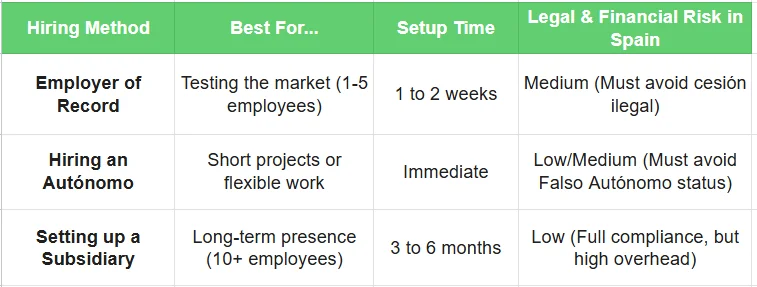
Note: An Autónomo is a registered freelance worker in Spain. If you hire an Autónomo who works exclusively for you full-time under your strict direction and uses your equipment, Spanish authorities may classify them as a Falso Autónomo (False Freelancer), leading to severe financial penalties and forced retroactive Social Security payments.
Key Costs and Employee Rights in 2026
When calculating your budget for hiring in Spain through an EOR, remember that your overall cost will be significantly higher than just the employee’s gross salary. You must cover the employee’s gross pay, the EOR’s monthly service fee (usually between €300 and €600 per employee), and the employer’s Social Security contributions. These contributions typically add an extra 30% to 32% on top of the gross salary.
Spanish workers enjoy incredibly strong legal protections. Your EOR must ensure compliance with the following minimums:
- Working Hours: A standard maximum of 40 hours per week.
- Vacation: At least 30 calendar days (which equates to 22 working days) of paid annual leave, plus up to 14 public holidays depending on the region.
- Severance Pay: Terminations are heavily regulated. Unfair dismissals (despido improcedente) generally require a severance payout of 33 days of salary per year worked, up to a maximum of 24 months’ pay.
- Extra Pay (Pagas Extraordinarias): By law, salaries in Spain are traditionally paid in 14 installments (with extra payments occurring in summer and at Christmas). However, these can often be prorated into 12 standard monthly payments if agreed upon in the contract.
Essential Steps for Onboarding Your Team
If you have decided that an EOR is the right path for your business, the onboarding process is surprisingly smooth if you prepare correctly.
Find the Right Partner
Do not use a low-cost aggregator. Ensure your chosen EOR provider actually owns a registered legal entity in Spain. Ask them explicitly how they protect clients from illegal assignment claims and if they have local legal counsel on staff.
Prepare the Candidate’s Documentation
Your new hire will need a valid Spanish ID (DNI) or an NIE (Número de Identidad de Extranjero or Foreigner’s Identification Number), a Spanish bank account (IBAN) to receive their monthly payroll, and an active Social Security Number.
Draft a Compliant Contract
Work hand-in-hand with the EOR to draft a localized contract. In 2026, following recent labor reforms, permanent contracts (contratos indefinidos) are the absolute standard. Temporary contracts are strictly limited to very specific, short-term situations by law and face heavy scrutiny.
Spain offers a fantastic pool of highly educated, multilingual professionals. By navigating the bureaucratic landscape carefully, respecting local labor laws, and choosing a compliant administrative partner, you can build a robust international team. Understanding the local nuances ensures that your expansion into the Spanish market is as rewarding and risk-free as possible.
Frequently Asked Questions (FAQs)
Can I hire an expat in Spain using an EOR?
Yes. An EOR can hire a foreign national, provided the individual already has the legal right to work in Spain (such as a valid work permit, a Digital Nomad Visa, or EU citizenship). Some high-end EORs also offer visa sponsorship services to help relocate talent, though this adds significant time and cost to the process.
Who is responsible if the employee sues for unfair dismissal?
In Spain, due to the concept of joint and several liability, the employee can sue both the EOR and your company. The EOR handles the legal proceedings as the formal employer, but the financial burden (such as the severance pay) is almost always passed down to you as the client, as stipulated in your commercial EOR service agreement.
Do I need a Spanish bank account to pay the EOR?
No, your company does not need a Spanish corporate bank account. You will typically pay the EOR via international wire transfer in your home currency or in euros. The EOR then uses its local Spanish bank account to distribute the net salary to the employee and remit the local taxes and Social Security contributions on your behalf.
If you need personalized assistance, at Entre Trámites we offer management and advisory services on immigration matters. You can contact us through this contact form for us to call you, or if you prefer, you can schedule a free consultation or write to us on WhatsApp.