Starting a business or relocating your life to a new country is a thrilling adventure, but financial roadblocks can happen to anyone. If you find yourself drowning in unpayable debts, you might be frantically searching for information on the Spanish bankruptcy law.
The very first thing you must understand is that Spain does not have an exact equivalent to the US Chapter 11 or the UK bankruptcy system, at least not by that name. Instead, the legal framework here is called Concurso de Acreedores (Insolvency Proceedings). Whether you operate as an Autónomo (a registered freelance professional in Spain) or you manage an SL (Sociedad Limitada – Limited Liability Company), dealing with severe debt requires navigating this specific legal terrain.
By 2026, the Spanish government has heavily streamlined these procedures to favor early debt restructuring rather than waiting for a business to completely collapse. Here is exactly what you need to know to protect yourself, your assets, and your peace of mind.
When to Consider Using the Spanish bankruptcy law
Recognizing when it is time to seek legal protection is crucial. Spanish law requires business administrators to file for insolvency within two months of knowing they cannot meet their financial obligations. Ignoring the problem will only increase your personal liability.
Current Insolvency vs. Imminent Insolvency
In Spain, you can file for protection under two scenarios. “Current insolvency” means you are already failing to pay your debts on time. “Imminent insolvency” means you foresee that you will not be able to pay your upcoming obligations in the next three months. Acting during the imminent phase gives you far more control over the outcome.
Warning Signs You Need to Act
How do you know it is time to consult an expert in Spanish bankruptcy law? Watch out for these red flags:
- You consistently fail to pay Hacienda (the Spanish Tax Agency) or Social Security on time.
- You are unable to cover payroll for your employees for three consecutive months.
- Your rent or leasing agreements for your commercial premises are heavily in arrears.
- The financial stress is impacting your health, and your debts clearly exceed your realistic income projections.
Demystifying Fears About the Spanish bankruptcy law
It is completely normal to feel terrified at the prospect of insolvency. However, many expats hold onto misconceptions based on how bankruptcy works in their home countries or from outdated rumors. Let’s clear up the biggest fears.
Myth: You will go to jail for business debts
Many entrepreneurs fear that failing to pay commercial debts is a criminal offense. Under Spanish legal standards, a judge will classify the bankruptcy as either Concurso Fortuito (accidental/honest failure) or Concurso Culpable (guilty/fraudulent failure). As long as you did not hide assets, falsify accounting records, or act with gross negligence, your business failure is considered an honest mistake. You will not face prison for a Concurso Fortuito.
Myth: You will lose your personal home immediately
If you are an individual or an Autónomo, you can access the Ley de Segunda Oportunidad (Second Chance Law). This specific mechanism allows honest debtors to cancel out debts they cannot pay. Under recent legal reforms, it is entirely possible to structure a payment plan that allows you to keep your primary residence, provided you meet strict criteria regarding the mortgage and asset valuation.
Core Legal Procedures and Paths to Recovery
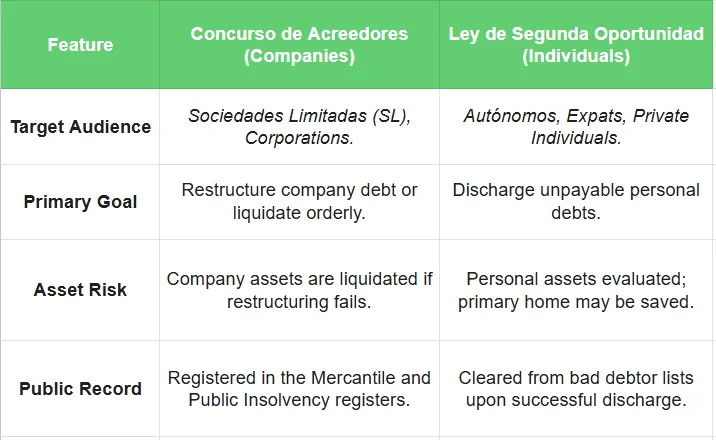
To make the best decision, you need to understand which procedure applies to your specific situation. The Spanish bankruptcy law treats corporate entities and physical persons differently.
Below is a breakdown of how the procedures compare, designed to help you quickly understand your options before consulting with a specialized tax advisor or reviewing the Spanish Official State Gazette (BOE) for regulatory updates.
How the Insolvency Process Begins
Taking the first step is often the hardest part. You cannot navigate this alone; the system is highly bureaucratic. You will legally need an Abogado (lawyer) and a Procurador (court representative) to file your petition at the Juzgado de lo Mercantil (Commercial Court).
Once accepted, the judge will appoint an Administrador Concursal (Insolvency Administrator). This professional steps in to oversee your finances, ensuring that your remaining assets are preserved and that your creditors are treated fairly according to the strict hierarchy established by the law.
Frequently Asked Questions (FAQs)
How long does the insolvency process take in Spain?
The duration heavily depends on the complexity of your case and the backlog of the specific Commercial Court handling it. Simple cases under the Second Chance Law can be resolved in 6 to 12 months, while complex corporate insolvency proceedings can easily drag on for several years.
Does the Spanish bankruptcy law apply to expats?
Yes. If your center of main interests (where you live, work, or manage your business) is located in Spain, you are subject to and protected by Spanish insolvency regulations, regardless of your nationality.
Can my business keep running during a Concurso de Acreedores?
Yes, in many cases. If your goal is to restructure rather than liquidate, the court often allows the business to continue operating under the supervision of the Insolvency Administrator. This ensures employees keep their jobs and the business generates revenue to pay off restructured debts.
Financial distress does not have to be a life sentence, nor should it ruin your experience of living in Spain. The legal frameworks exist specifically to give honest entrepreneurs and individuals a clean slate. By acting promptly at the first signs of trouble and leaning on specialized legal counsel, you can navigate the bureaucracy, protect your core assets, and rebuild your financial future on solid ground.
If you need personalized assistance, at Entre Trámites we offer management and tax advisory services for freelancers and SMEs. You can contact us through this contact form for us to call you, or if you prefer, you can schedule a free consultation or write to us on WhatsApp.