Temporary residency in Spain through “exceptional circumstances” is a legal pathway designed for non-EU citizens who are currently in the country in an irregular situation (without papers) to obtain a residence permit and, in most cases, a work permit.
Technically known as Residencia temporal por circunstancias excepcionales, this legal figure is regulated by Spanish Immigration Law. It is designed to provide a solution for humanitarian situations or for people who have established deep roots (arraigo) in the country but do not fit into ordinary immigration procedures. It is a complex path, but a vital one for the regularization of thousands of people every year.
Understanding the different types of temporary residency in Spain available under this scheme, along with their specific requirements, is fundamental to starting your process correctly. Below, we break down the main categories and exactly what you need to apply for them.
Types of Residency by Exceptional Circumstances (Arraigo)
Spanish regulations provide several modalities. However, the most common and relevant ones for those seeking to regularize their status are the “Arraigos” (Roots).
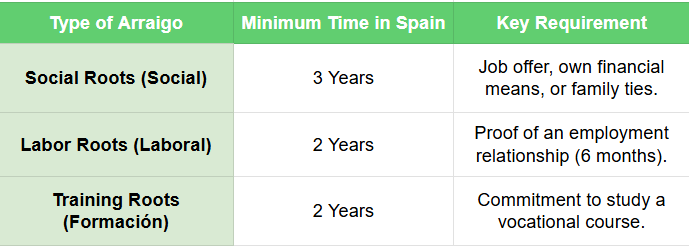
To help you scan the information quickly, here is a comparison of the three most popular types:
Arraigo Social (Social Roots)
This is the most common type. It is granted to foreign citizens who have lived continuously in Spain for a minimum of three years. To be approved, you must prove:
- Integration: Either through family ties with other legal residents/Spanish citizens OR a “Social Integration Report” (Informe de arraigo) issued by your Autonomous Community.
- Clean Record: You must lack criminal records in Spain and in your country of origin.
- Economic Means: You generally need a job offer (contract) for at least one year. Alternatively, you can demonstrate you have your own financial means or a business plan to become self-employed.
Arraigo Laboral (Labor Roots)
This allows for the regularization of those who have lived in Spain for at least two years and can prove a past employment relationship of at least six months. The key requirements are:
- Continuous residence of two years.
- Lack of criminal records.
- Proof of employment relationship: This is the tricky part. You must prove you worked (legally or illegally) through an administrative resolution (like a Labor Inspection report) or a court ruling confirming the employment relationship exists.
Arraigo para la Formación (Roots for Training)
This is one of the most recent additions to the law, designed to help foreigners get trained in sectors where Spain needs workers. To get this temporary residency in Spain, you need:
- Continuous residence of two years.
- Lack of criminal records.
- Commitment to study: You must commit to undertaking regulated vocational training for employment (Formación Profesional) or a certificate of professionalism in a sector with high labor demand.
Other Exceptional Circumstances
- Collaboration with Authorities: Applied to people who have collaborated with the police, judicial authorities, or the Prosecutor’s Office in the fight against organized crime, human trafficking, or sexual exploitation.
- Humanitarian Reasons: Granted to people who cannot return to their country of origin due to verified health reasons, danger to their safety, or for being victims of certain crimes (such as gender-based violence).
General Requirements and Application Process
Regardless of which type of temporary residency in Spain via exceptional circumstances you apply for, there are common “deal-breaker” requirements you must meet:
- Not be a citizen of the EU, EEA, or Switzerland.
- Not be prohibited from entering Spain or the Schengen territory.
- Have absolutely no criminal records in Spain or in your previous countries of residence for the last 5 years.
The application process starts at the Immigration Office (Oficina de Extranjería) of the province where you live. You must submit the official application form (Model EX-10) along with all the documentation proving your continuous residence (usually the Padrón helps here) and the specific requirements for your type of Arraigo.
Important: Your application must be accompanied by all necessary documents from day one. The Administration can deny your petition simply because the documentation is incomplete. If you have doubts, getting professional advice is crucial to avoid delays.
Obtaining temporary residency in Spain through exceptional circumstances is a crucial tool in the Spanish immigration system. With a correct understanding of the requirements and meticulous preparation of your paperwork, this pathway offers you the opportunity to regularize your situation and start a new life in Spain legally.
If you need personalized assistance, at Entre Trámites we offer management and advisory services on immigration matters. You can contact us through this contact form for us to call you, or if you prefer, you can schedule a free consultation or write to us on WhatsApp.
Frequently Asked Questions
Can I work with a temporary residency by exceptional circumstances?
Yes, in most cases. Approvals for Arraigo Social and Arraigo Laboral automatically imply a work permit (valid for both employed and self-employed work). However, Arraigo para la Formación initially grants residency to study; you can modify it to a work permit later once you finish your training and find a job.
How do I prove I have lived in Spain continuously?
The most valid and accepted proof is the Padrón Histórico (census registration). However, you can also use medical records, bank transactions, or invoices in your name that show you have remained in Spain during the required period (2 or 3 years depending on the type).
What happens if my application is rejected?
If your application for temporary residency in Spain is denied, you have the right to appeal. You can file an administrative appeal (Recurso de Reposición) within one month or go to court (Recurso Contencioso-Administrativo) within two months. It is highly recommended to have a lawyer review the reasons for rejection before appealing.