Are you planning your relocation to the Iberian Peninsula? Whether you are drawn by the sunny weather, the vibrant culture, or remote work opportunities, proper financial preparation is crucial. When you prepare to start a new life in Spain, understanding the local bureaucracy regarding residency, banking, and taxation will save you countless headaches down the road. This updated guide walks you through the exact steps you need to take in 2026 to ensure your transition is smooth, legal, and financially optimized.
Residency Visas to start a new life in Spain
Before you pack your bags, you must secure the right legal status. Your residency type directly impacts your tax obligations, so you must choose carefully based on your income sources.
Perfect for remote workers and freelancers whose clients are primarily located outside of Spain. It offers a fast track to residency and potential tax benefits for up to five years, provided you meet the minimum income requirements.
Designed for retirees or individuals with substantial passive income. You cannot work locally or remotely under this visa, meaning you must rely on verifiable savings, investments, or pensions to sustain yourself.
Highly Qualified Professional Permit
If a Spanish company sponsors you for a specialized or managerial role, this permit expedites your arrival and often opens the door to highly preferential tax regimes.
If you hold a passport from an EU member state, you have freedom of movement. However, you still need to register locally to get your green NIE certificate and prove you have sufficient financial means and healthcare coverage.
Setting Up Your Daily Finances and Banking
Once you arrive, securing a local bank account should be your top priority. You will need a
Spanish IBAN to pay your rent, set up utility direct debits, and receive a local salary.
Resident vs. Non-Resident Accounts
If you have not yet secured your physical residency card (TIE), you can open a non-resident account using just your passport and a non-resident NIE. Once you become an official resident, you must notify your bank to switch your account to a resident profile, which usually offers much lower maintenance fees.
Required Documents for Banking
To open a resident account, you generally need to visit a branch or apply online with the following documents:
- Valid Passport or National ID.
- Your NIE (Foreigner Identity Number) or TIE.
- Proof of address, typically your empadronamiento certificate from the local town hall.
- Proof of income, such as a recent employment contract, tax return, or pension statement.
- Tax Identification Number (TIN) from your home country.
Navigating Taxes and International Assets
Spain uses a residence-based taxation system. If you spend more than 183 days in the country during a calendar year, or if your main center of economic interests is there, you become a tax resident. This means you must declare your worldwide income to the Spanish Tax Agency.
Avoiding Double Taxation
Fortunately, Spain holds Double Taxation Agreements (DTAs) with dozens of nations, including the US, UK, and Canada. These treaties prevent you from paying tax twice on the same income stream, allowing you to apply foreign tax credits on your Spanish income tax return (IRPF).
The Beckham Law Advantage
If you relocate for an employment contract or as a qualifying digital nomad, you might be eligible for the Special Tax Regime for Inbound Workers, commonly known as the Beckham Law. In 2026, this regime allows qualifying foreigners to pay a flat 24% tax rate on Spanish-sourced income up to €600,000, instead of facing progressive rates that can reach 47%. Crucially, it generally exempts your foreign investments, capital gains, and real estate from Spanish
taxation for the year of arrival plus five additional years.
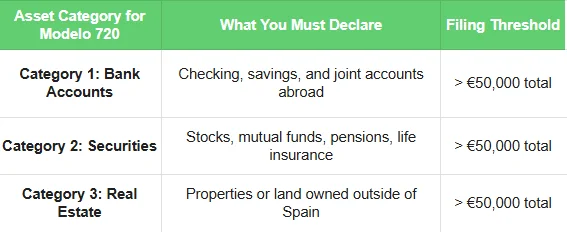
Form 720 (Modelo 720)
If you are a standard tax resident (and do not apply for the Beckham Law), you must file Modelo 720. This is an informative declaration of assets held abroad. You only need to report if the total value in any of three specific categories exceeds €50,000. After your initial filing, you only have to submit it again in subsequent years if the value of a previously declared category increases by more than €20,000.
Final Steps to start a new life in Spain Successfully
Relocating to another country is a marathon, not a sprint. To truly enjoy your transition and start a new life in Spain without administrative stress, keep these practical tips in mind:
Keep digital and physical folders of all your certified documents, such as birth and marriage certificates. Make sure they bear the Hague Apostille before you leave your home country.
Learn basic financial Spanish vocabulary. Knowing terms like nómina (payslip), declaración de la renta (income tax return), and Seguridad Social (Social Security) will speed up your integration and give you confidence when dealing with officials.
If you hold complex assets, property abroad, or multiple passive income streams, consult with a certified fiscal advisor. Proper tax planning before you change your residency can save you thousands of euros annually.
Frequently Asked Questions (FAQs)
Can I open a Spanish bank account before arriving in the country?
Yes, some Spanish banks offer non-resident accounts that can be opened online before you arrive, requiring only your passport and your home country’s tax identification number. However, you will eventually need to convert this to a resident account once you obtain your TIE.
Do I have to pay Spanish taxes if my salary comes from a foreign company?
Yes. If you live in Spain for more than 183 days a year, you are considered a tax resident. You must declare your worldwide income, including salaries from foreign employers, unless you are covered by a specific double taxation treaty or the Beckham Law.
What happens if I forget to file Modelo 720?
Failing to file Modelo 720 or submitting it late can trigger administrative penalties. While the European Court of Justice recently ruled against the previously disproportionate fines, standard tax penalties and increased scrutiny from the tax agency still apply.
Moving abroad requires careful planning, but the lifestyle reward is immense. By securing the correct visa, setting up your banking promptly, and proactively managing your tax obligations—whether that means filing Modelo 720 or applying for the Beckham Law—you protect your financial health for years to come.
If you need personalized assistance, at Entre Trámites we offer management and tax advisory services for freelancers and SMEs. You can contact us through this contact form for us to call you, or if you prefer, you can schedule a free consultation or write to us on WhatsApp.