Last updated: October 2026 – Content reviewed according to current regulations.
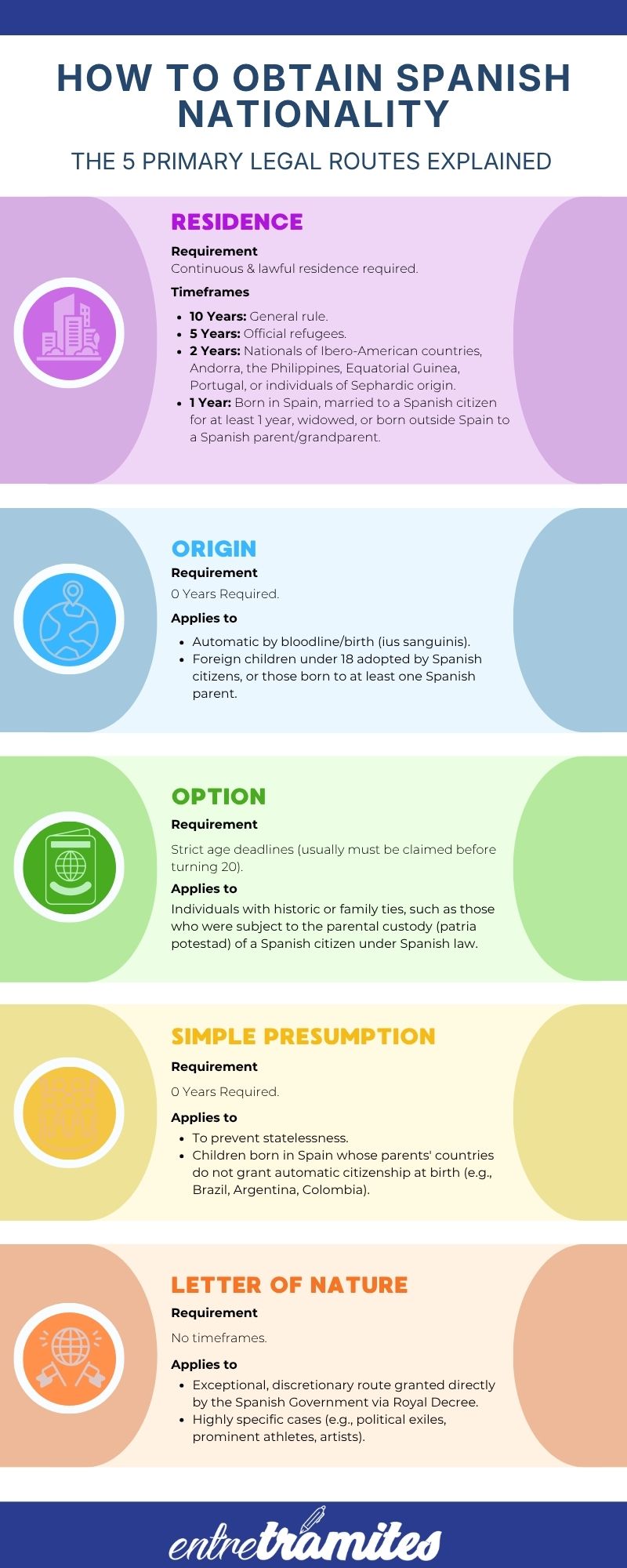
Obtaining Spanish nationality grants you full European Union citizenship, enabling you to live, work, and vote anywhere in Spain and the EU. You can acquire it through five legal pathways set by the Civil Code: residence, origin, option, simple presumption, and letter of nature.
Who it applies to: Foreign residents with continuous legal status in Spain, descendants of Spanish citizens, spouses of Spanish nationals, and individuals born on Spanish territory under specific conditions.
When it does not apply: Foreigners residing in Spain on a student visa or holding an irregular status, as time spent on a student visa legally counts as a stay (estancia), not legal residence (residencia).
What is Spanish Nationality?
Spanish nationality is the legal bond established between an individual and the Spanish State. Acquiring citizenship gives you fundamental rights, such as a European passport and unrestricted labor mobility within the EU. Conversely, it establishes civic duties, including tax compliance and adherence to national laws.
Depending on your birthplace, family background, and time living in Spain, the Civil Code outlines distinct routes to apply. Knowing the exact criteria ensures a smooth application before the Ministry of Justice (Ministerio de Justicia) or the Civil Registry.
Primary Routes to Acquire Spanish Nationality
Spanish law provides multiple pathways to obtain citizenship. Each mechanism targets a specific demographic profile, requiring distinct evidence and processing steps.
1. Spanish Nationality by Residence
Applying by residence is the most common path for expats. To apply, you must demonstrate uninterrupted, legal residence in Spanish territory immediately preceding your application.
The required residence period varies by your origin:
- 10 Years: The general rule for most foreign nationals.
- 5 Years: For individuals who hold official refugee status in Spain.
- 2 Years: For nationals of Ibero-American countries, Andorra, the Philippines, Equatorial Guinea, Portugal, or individuals of Sephardic origin.
- 1 Year: For individuals born in Spain, those married to a Spanish citizen for at least one year (not legally separated), widows/widowers of Spaniards, and children born outside Spain to a Spanish parent (who was also born outside Spain).
Applicants aged 18 and over must pass two official Cervantes Institute exams: the DELE A2 language exam and the CCSE socio-cultural exam. Nationals of countries where Spanish is the official language are exempt from the DELE A2 (note: Brazilian nationals must still take this exam). There is no automatic upper age limit exemption; older adults must take the exams unless they secure a specific waiver from the Ministry of Justice.
2. Spanish Nationality by Origin
Under Article 17 of the Civil Code, you are automatically Spanish by origin if you fulfill any of these criteria:
- Born to a Spanish mother or father.
- Born in Spain to foreign parents if at least one parent was also born in Spain (excluding children of accredited diplomats).
- Born in Spain to stateless parents, or if neither parent’s national law attributes nationality to the child.
- Born in Spain with undetermined parentage.
3. Spanish Nationality by Option
Nationality by option is a legal benefit granted to foreigners connected to Spanish family members. Under Article 20 of the Civil Code, you qualify if:
- You are or were subject to the parental authority of a Spanish citizen (e.g., minor children whose parents just obtained citizenship by residence).
- Your father or mother was originally Spanish and born in Spain.
- You apply under special frameworks, like the Democratic Memory Law, which benefits descendants of Spanish exiles.
4. Spanish Nationality by Simple Presumption
To prevent statelessness, if a child is born in Spain to foreign parents whose home countries do not transmit citizenship to children born abroad, Spain grants citizenship by simple presumption. Countries whose nationals often qualify under this rule include Argentina, Brazil, Colombia, and Cuba, subject strictly to consular non-registration certificates.
5. Spanish Nationality by Letter of Nature
Obtaining Spanish nationality by letter of nature (carta de naturaleza) is an ex gratia grant by the Council of Ministers via Royal Decree. It is strictly reserved for exceptional circumstances, such as notable sporting or humanitarian contributions to Spain.
Legal Requirements by Category
To compare the main options, this table summarizes the legal criteria and documentation needed for each process:
| Nationality Route | Required Residence | Essential Documentation |
| Residence (General) | 10 continuous years | Criminal record certificate, full passport, DELE A2 & CCSE, padrón |
| Residence (Ibero-America) | 2 continuous years | Birth certificate, criminal record, CCSE certificate (DELE exempt) |
| Residence (Spouse) | 1 year married + resident | Marriage certificate, spouse’s DNI, cohabitation padrón |
| Option (Minors) | None (parental authority) | Parent’s Spanish birth certificate, minor’s birth certificate, family book |
| Simple Presumption | Born in Spain | Child’s birth certificate, consular non-registration, parents’ passports |
Processing Your Application
Most applications by residence are submitted electronically through the Ministry of Justice portal using a Digital Certificate. Once filed, the Ministry reviews your criminal records, residence continuity, and exams. While the law dictates a maximum of one year to resolve the file, current bureaucratic backlogs mean actual processing times often stretch from 1 to 3 years. Once granted, you have a strict 180-day window to take the oath of allegiance (jura de nacionalidad). You can do this at your local Civil Registry or, to speed things up, at a notary public, which finalizes the process and allows you to obtain your Spanish DNI and passport.
Frequently Asked Questions (FAQs)
Can I lose my Spanish nationality once I obtain it?
Yes. Naturalized citizens can lose their citizenship if they reside abroad and exclusively use their previous nationality for a period of three years, or if they obtained the Spanish citizenship through fraud, concealment, or falsification of documents.
Do I have to renounce my original citizenship to acquire Spanish nationality?
Unless you are a national of an Ibero-American country, Andorra, the Philippines, Equatorial Guinea, Portugal, or France, Spanish law requires you to formally renounce your previous nationality when taking your oath of allegiance.
Does a student visa count toward the residence requirement?
No. A student visa in Spain is legally classified as a stay (estancia), not residence (residencia). Therefore, the years spent studying do not count toward the 10-year or 2-year continuous residence requirement for citizenship.
Obtaining citizenship is the ultimate goal for many expats, granting stability and absolute legal equality in the country. While the requirements and exams demand meticulous preparation, understanding the exact route you qualify for prevents severe delays. If you are preparing your electronic application, seeking guidance from expert immigration lawyers guarantees that your documentation complies perfectly with the Ministry of Justice’s rigorous standards.
If you need personalized assistance, at Entre Trámites we offer management and advisory services on immigration matters. You can contact us through this contact form for us to call you, or if you prefer, you can schedule a free consultation or write to us on WhatsApp.