
Last updated: October 2026 – Content reviewed according to current regulations.
The Crea y Crece Law (Law 18/2022) reduces the minimum share capital required to set up a Limited Liability Company (SL) in Spain from €3,000 to just €1 and mandates mandatory electronic invoicing for all B2B transactions to combat late payments.
Who it applies to: Entrepreneurs incorporating new companies in Spain, existing Small and Medium-sized Enterprises (SMEs), and freelancers (autónomos) invoicing other businesses.
When it does not apply: Consumers (B2C transactions), which are not subject to the mandatory B2B e-invoicing rollout.
Primary Objectives of the Crea y Crece Law
Officially enacted as Law 18/2022 on the Creation and Growth of Companies, the Crea y Crece Law eliminates historical administrative barriers that hindered entrepreneurship in Spain.
The reform targets three key areas of the Spanish corporate ecosystem:
- Incorporation Flexibility: Lowering the economic threshold to start a Limited Liability Company (Sociedad Limitada).
- Alternative Financing: Making regulatory frameworks for crowdfunding, collective investment, and venture capital more flexible.
- Combating Late Payments: Implementing strict traceability on commercial transactions to ensure suppliers are paid within legal deadlines.
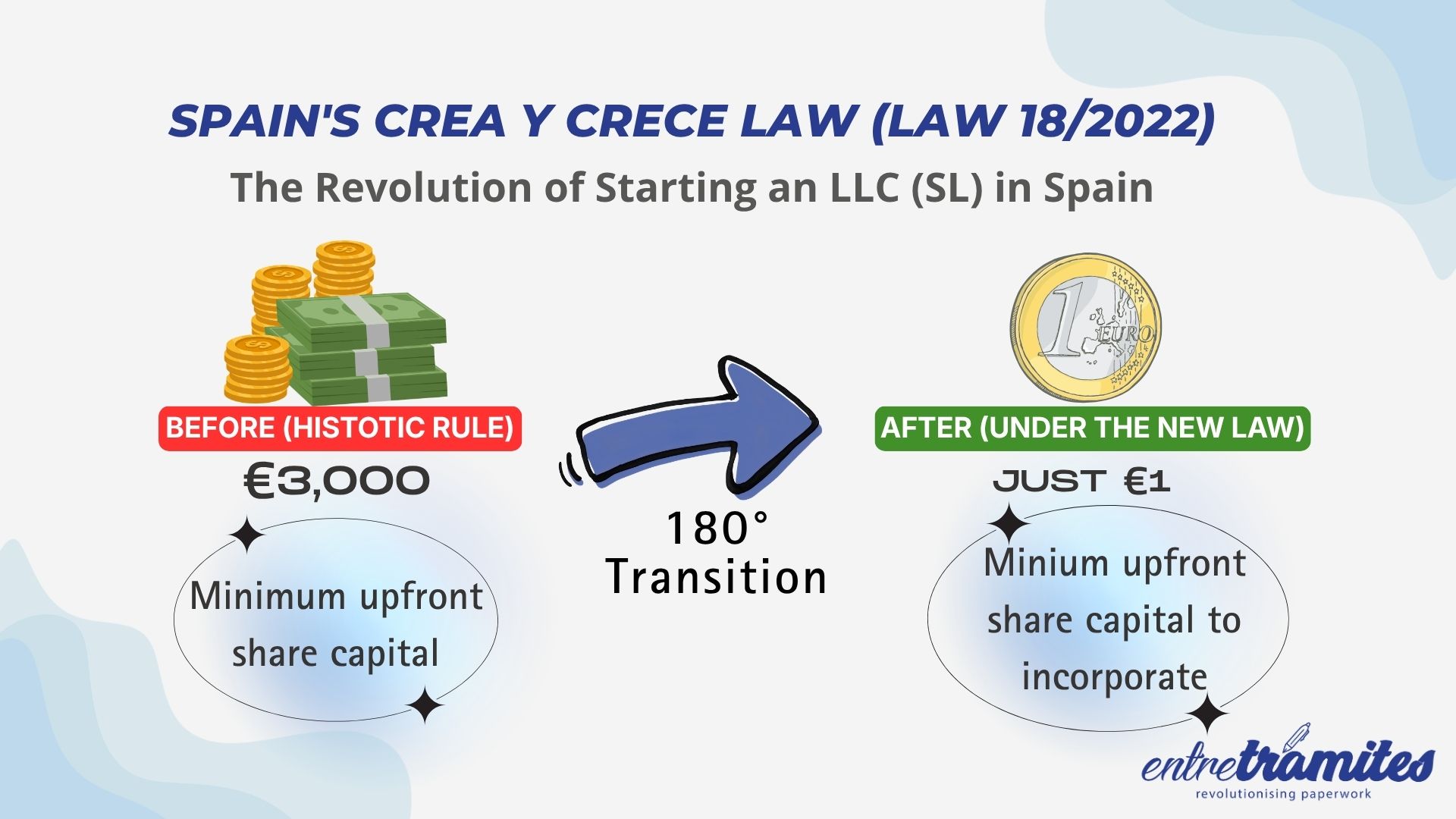
Incorporating an LLC with €1 of Share Capital
Historically, establishing a standard Limited Liability Company (LLC or SL) in Spain required a minimum upfront deposit of €3,000. Under the Crea y Crece Law, founders can now formally incorporate an SL with a minimum share capital of just €1.
However, to protect creditors, companies operating with a share capital below €3,000 are subject to a strict transitional regime until their capital and reserves reach the traditional €3,000 threshold.
Special Regime Rules for €1 Companies
If you choose to incorporate with less than €3,000, you must adhere to the following mandatory legal and financial conditions:
| Financial Obligation | Description and Legal Requirement |
| Legal Reserve Allocation | You must allocate at least 20% of the company’s annual profit to the legal reserve until the combined sum of the share capital and the legal reserve reaches €3,000. |
| Shareholder Liability | In the event of voluntary or compulsory liquidation, if the company’s assets cannot cover its debts, the shareholders are jointly and severally liable for the difference between €3,000 and the subscribed capital amount. |
| Repealed Corporate Forms | The law officially abolishes the Sociedad Limitada Nueva Empresa (SLNE) and the Sociedad Limitada de Formación Sucesiva (SLFS). Existing SLFS entities can adopt the new regime or maintain their previous status under the repealed LSC Art. 4 bis. |
Promoting Telematic Company Incorporation
To accelerate the setup phase, the Crea y Crece Law enforces the digitalization of the incorporation process. Founders can bypass slow, paper-based bureaucratic steps by utilizing the Service Points for Entrepreneurs (PAE) and the Single Electronic Document (DUE) via the CIRCE telematic system.
New Obligations for Notaries and Registries
The legislation imposes strict mandates on Spanish Notaries and the Commercial Registry (Registro Mercantil) to facilitate electronic processing:
- Mandatory Notarial Availability: Notaries must maintain availability in the Notarial Electronic Agenda and cannot reject an incorporation procedure initiated via CIRCE without justified legal cause.
- Standardized Bylaws: If the company is incorporated using standardized bylaws (estatutos tipo) through the telematic system, the publication of the company’s registration in the BORME (Official Gazette of the Mercantile Registry) is entirely exempt from fees. The government provides these standard templates in national Spanish as well as all co-official regional languages.
- Accelerated Registration: For incorporations without standardized bylaws, the Commercial Registry must complete the definitive registration within 5 working days from the filing entry, abandoning the previous 15-day limit.
Mandatory E-Invoicing and the Observatory Against Defaulting
Late payments drastically impact the liquidity of Spanish SMEs. To eradicate this, the Crea y Crece Law mandates that all companies and freelancers must issue and receive electronic invoices (e-invoicing) for commercial B2B transactions.
This digital traceability allows the Tax Agency to monitor the exact date an invoice is issued and paid. This initiative aligns with the Veri*factu regulations, ensuring that billing software guarantees the inalterability of transaction records.
Furthermore, the government established the State Observatory of Private Defaulting (Observatorio Estatal de la Morosidad Privada). This regulatory body analyzes payment terms across sectors, promotes transparent commercial practices, and publishes an annual public “blacklist” of companies that systematically default on their payment obligations.
Frequently Asked Questions (FAQs)
Can I really set up a company in Spain for 1 euro?
Yes. You can incorporate a Limited Liability Company (SL) with €1. However, you must allocate 20% of your annual profits to a legal reserve until the reserve and share capital combined reach the traditional €3,000 threshold.
Are electronic invoices mandatory under this new law?
Yes. The law establishes the mandatory use of electronic invoicing for all B2B (business-to-business) transactions in Spain to trace payment deadlines and prevent commercial defaulting.
What happens to the existing SLNE and SLFS company types?
The law officially abolishes the Sociedad Limitada Nueva Empresa (SLNE) and the Sociedad Limitada de Formación Sucesiva (SLFS). Existing companies under these formats are automatically transitioned into standard Limited Liability Companies.
Navigating Spanish corporate compliance has become significantly more agile, yet stricter on digital traceability. By lowering the capital entry barrier and digitizing the incorporation process, the government aims to stimulate foreign and domestic investment. However, adapting to the mandatory electronic invoicing requirements requires immediate action from business owners. Ensuring your accounting software and incorporation structure comply with these new mandates protects your venture from shareholder liabilities and government penalties.
If you need personalized assistance, at Entre Trámites we offer management and tax advisory services for freelancers and SMEs. You can contact us through this contact form for us to call you, or if you prefer, you can schedule a free consultation or write to us on WhatsApp.