Moving to the Iberian Peninsula is a dream come true for many. You buy a beautiful house, set up your Spanish bank accounts, and settle into the Mediterranean lifestyle. But amid all the excitement, expats often overlook one crucial administrative task: planning for the future. If you own property or have financial assets here, drafting a will in Spain is one of the smartest and most protective steps you can take for your loved ones.
Navigating foreign inheritance laws can feel daunting, but it doesn’t have to be. By understanding how the local system works, you can ensure your assets are distributed exactly as you wish, saving your heirs from months of cross-border bureaucracy and unnecessary legal fees.
Why every expat needs a will in Spain
In Spain, a will is known as a Testamento. While it is true that a valid will from your home country can technically cover your Spanish assets, relying on it is a massive bureaucratic trap.
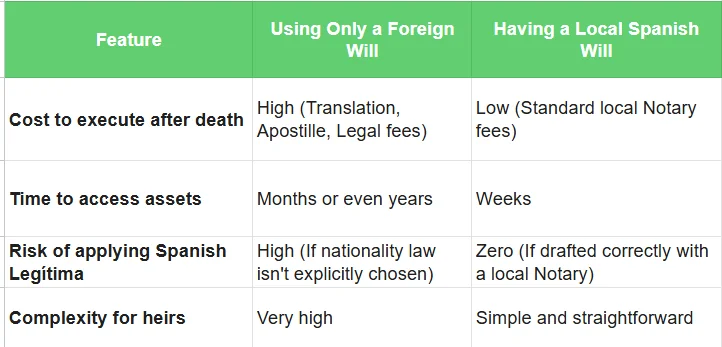
If your heirs only have your foreign will when you pass away, they will have to get it translated into Spanish by a sworn translator, legalized with an Apostille, and potentially validated by a Spanish judge. This process can take months and cost thousands of euros.
Having a separate Spanish document exclusively for your assets located in Spanish territory drastically simplifies the probate process. Your heirs can quickly take the document to a local professional and start settling the estate immediately.
Understanding Forced Heirship
The most critical reason to act is the Spanish inheritance rule known as the Legítima (forced heirship). Unlike in the UK or the US, where you enjoy “testamentary freedom” and can leave your estate to anyone you choose, Spanish civil law strictly dictates how your assets are divided. Under the Legítima, two-thirds of your estate must legally go to your children or descendants.
The Magic Clause for your will in Spain
If you are living here full-time, the law assumes that Spanish inheritance rules—including the Legítima—apply to your estate by default. This can be disastrous if you intended to leave everything to your spouse, as Spanish law prioritizes your children.
Fortunately, there is a legal workaround. Thanks to the European Succession Regulation (often called Brussels IV), any expat residing in the EU can choose to have the inheritance laws of their nationality apply to their estate upon death.
To use this protection, when creating your will in Spain, you must explicitly include a clause stating that you want the law of your home country (e.g., British law, American law) to govern your inheritance. This completely bypasses the Spanish forced heirship rules, allowing you to distribute your Spanish assets exactly how you want. In 2026, Notaries are very accustomed to this request from expats, so the process is highly standardized.
Spanish Will vs. Foreign Will for Spanish Assets
To help you visualize the difference, here is a quick breakdown of what happens when you rely on a foreign document versus having a local one:
Step-by-Step: Formalizing your will in Spain
Drafting and registering a will in Spain is remarkably affordable and straightforward. The most common and secure type is the Open Will (Testamento Abierto). Here is how you do it:
Draft the document
You can draft the document yourself, but it is highly recommended to use an English-speaking Spanish lawyer to ensure the translation is accurate and the Brussels IV nationality clause is correctly applied.
Visit the Notary
You must sign the document in person before a Notario (Public Notary), an official who guarantees the legality of the document. You will need your passport and your NIE (Foreigner Identity Number). If your Spanish is not fluent, the Notary will require a translator to be present so you fully understand what you are signing.
Official Registration
Once signed, the Notary automatically registers the existence of your document in the Registro de Actos de Última Voluntad (the Central Registry of Last Wills) in Madrid. They do not send the contents of the will, just the fact that it exists and where it was signed. This guarantees that when the time comes, your heirs can easily locate the official deed.
Securing your family’s financial future in a foreign country is an act of love. By taking a few hours to formalize your wishes under Spanish law and utilizing international legal frameworks, you ensure that your assets smoothly transfer to the people you care about most. For more information on cross-border successions, you can always check resources like the European e-Justice Portal. Protect your peace of mind so you can focus on enjoying your life in Spain.
Frequently Asked Questions (FAQs)
Do I need a new Spanish will if I update the one in my home country?
Not necessarily, but you must be very careful. If you write a new will in your home country and include a standard clause that says “I hereby revoke all previous wills,” you might accidentally cancel your Spanish one. Always tell your lawyer back home that you have a separate document in Spain that should remain untouched.
How much does it cost to make this document at a Notary?
Signing an open will at a Spanish Notary is surprisingly inexpensive. The standard Notary fee is usually between €50 and €80. If you hire a lawyer to draft it bilingually and advise you on the clauses, their professional fees will be added to this, typically bringing the total to a few hundred euros.
Does a Spanish will cover my assets back in my home country?
You can technically draft it to cover worldwide assets, but it is highly discouraged. Just as a foreign will causes bureaucratic headaches in Spain, a Spanish one will cause massive delays and translation costs for your heirs trying to claim a bank account or property in the UK, US, or elsewhere. It is always best to have one will per country where you hold significant assets.
If you need personalized assistance, at Entre Trámites we offer management and tax advisory services for freelancers and SMEs. You can contact us through this contact form for us to call you, or if you prefer, you can schedule a free consultation or write to us on WhatsApp.