If you bought a residential property in Spain years ago, you might still be sitting on one of the most valuable tax benefits in the Spanish Personal Income Tax (IRPF) system. Although Spain officially abolished the general national home purchase tax relief for new buyers on January 1, 2013, a special transitional regime allows eligible homeowners to continue saving up to €1,356 every single year.
However, navigating the Spanish Tax Agency (Agencia Tributaria) regulations requires precision. In 2026, tax authorities continue to closely review tax returns claiming this benefit. Understanding how the tax deduction for buying a home works, what expenses you can include, and how to avoid costly administrative mistakes will protect your hard-earned money.
Who Qualifies for the Tax Deduction for Buying a Home?
To legally claim the tax deduction for buying a home under Spain’s transitional regime (régimen transitorio), you must meet three strict criteria established by Spanish tax law:
1. Acquisition date prior to 2013
You must have purchased your primary residence, or paid for its construction, rehabilitation, or expansion, before January 1, 2013.
2. Previous tax claim history
You must have applied this deduction in your IRPF return for the 2012 tax year or earlier. The primary exception applies if you did not file a return back then because your total income fell below the mandatory filing threshold, or if you were previously claiming a deduction on another primary property that you subsequently sold.
3. Strict primary residence status
The property must be your primary residence (vivienda habitual). Under Spanish regulations, this means you must occupy the home within twelve months of purchase and live in it continuously for at least three consecutive years. Interruptions are only permitted for legally justified reasons, such as job relocation, marriage, divorce, or disability.
Eligible Expenses and Annual Deduction Limits
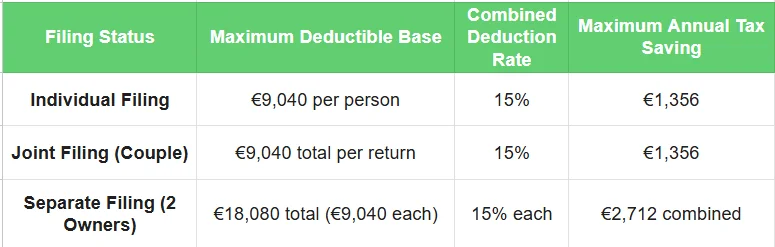
The deduction is calculated as a percentage of the total amount you paid toward financing your home during the calendar year. The maximum deductible base is capped at €9,040 per taxpayer per year.
The standard deduction rate is 15%, which is split equally into two parts:
- State portion: 7.5%
- Regional portion: 7.5% (Note: Autonomous Communities can exercise regulatory powers to adjust this rate, so your regional percentage may vary depending on where you reside).
This structure means an individual taxpayer can achieve a maximum direct reduction on their final tax bill of €1,356 per year (€9,040 × 15%).
If a married couple owns the home jointly and files separate IRPF tax returns (declaración individual), each spouse can claim up to €9,040 from their own bank account payments, effectively doubling the household limit to €18,080 per year for a combined tax saving of €2,712.
What expenses can you actually include toward that €9,040 annual limit?
- Mortgage payments: Both the loan principal (amortization) and the accrued interest paid during the tax year.
- Mandatory mortgage insurance: Premium payments for life, fire, or home insurance policies, provided that your mortgage contract explicitly required them as a condition for granting the loan.
- Refinancing costs: Administrative, notary, and registry fees incurred when restructuring or transferring your mortgage (novación or subrogación), as long as the new capital is used exclusively for the original home loan.
Key Pitfalls and Common Mistakes to Avoid
Because the tax deduction for buying a home represents significant tax relief, the Spanish Tax Agency routinely audits these claims. Here are the most frequent errors that trigger penalties or tax adjustments:
Renting out the property
If you move out and rent the property to tenants—or leave it vacant while living elsewhere—it immediately loses its official status as your primary residence. You must stop claiming the deduction for any period the home is not your main residence. If you move back in later, you can resume deducting only after living there for another three continuous years, unless a legal exception applies.
Including non-qualifying mortgage expansions
If you refinanced your mortgage to equity-release extra cash for buying a vehicle, funding travel, or paying off personal debt, you cannot deduct the interest or principal corresponding to that extra cash. You must mathematically separate the original home purchase loan balance from the additional funds.
Failing to retain supporting documentation
You must keep bank receipts, annual mortgage certificates, insurance contracts, and tax returns for at least four years (the standard statutory limitation period in Spain). If audited, the burden of proof rests entirely on you.
How to Claim the Benefit on Your IRPF Return
When completing your annual Spanish income tax return (Declaración de la Renta), locate the section dedicated to the transitional deduction for investment in primary residence (Deducción por inversión en vivienda habitual. Régimen transitorio).
Enter the exact amounts paid for mortgage principal, interest, and mandatory insurance under boxes 0698 and 0699 (or the corresponding active boxes for the current tax campaign). The tax portal will automatically calculate the state and regional breakdowns and apply the deduction directly against your tax liability.
Securing these ongoing tax savings requires attention to detail and full compliance with Spanish Tax Agency guidelines. By keeping clear documentation and filing accurately each year, you can safely optimize your IRPF return and keep more money in your pocket.
Frequently Asked Questions (FAQs)
Can I keep claiming the tax deduction for buying a home if I refinanced my mortgage?
Yes, provided the refinanced loan is used exclusively to pay off the original home purchase mortgage. You can deduct administrative and notary fees associated with the refinancing (novación), but any extra capital borrowed for personal spending is strictly non-deductible.
What happens to the tax deduction for buying a home if I get a divorce?
If one ex-spouse continues paying the mortgage on the former primary residence where their children and former partner reside, Spanish tax law allows that paying ex-spouse to continue applying the deduction on their share of payments, up to the annual €9,040 base limit.
Is mandatory life insurance deductible under this home purchase benefit?
Yes, premiums for life or home insurance policies are deductible as part of the €9,040 annual limit, provided the insurance was explicitly required by your lending bank in the original mortgage contract.
If you need personalized assistance, at Entre Trámites we offer management and tax advisory services for freelancers and SMEs. You can contact us through this contact form for us to call you, or if you prefer, you can schedule a free consultation or write to us on WhatsApp.