Last updated: October 2026 – Content reviewed according to current regulations.
The Spanish Digital Nomad Visa allows UK citizens to live and work remotely in Spain for up to three years while legally maintaining their employment or freelance activity abroad.
Who it applies to: UK remote workers (employees of foreign companies) and self-employed professionals (freelancers with foreign clients) who earn at least €2,850 per month and hold a university/postgraduate degree or at least 3 years of relevant professional experience.
When it does not apply: UK citizens wishing to work for Spanish companies locally, retirees living on passive income (who must apply for the Non-Lucrative Visa), or tourists visiting for less than 90 days.
Exactly What is a Digital Nomad Visa in Spain?
If you are asking what is a digital nomad visa, it is a specific residency permit created under Spain’s Startup Law (Ley 28/2022). It grants non-EU nationals the legal right to reside in Spain while working entirely remotely through computer and telematics systems. For UK citizens post-Brexit, it replaces the restrictive 90-day tourist limit, offering a fast-track to Spanish residency and eventual citizenship.
Unlike tourist visas, this permit allows you to legitimately work from Spain without infringing on immigration or labor laws. It provides a formal pathway for high-earning remote professionals to integrate into the Spanish system, secure long-term housing, and access public or private healthcare infrastructure.
Financial and Professional Requirements for 2026
Do not confuse this visa with the Non-Lucrative Visa, which strictly prohibits work. The digital nomad route requires active remote income, tied directly to the Spanish Minimum Interprofessional Wage (SMI).
To qualify, UK applicants must meet stringent criteria monitored by the Large Business and Strategic Groups Unit (UGE-CE):
- Income Threshold: The law requires applicants to prove an income equivalent to 200% of the Spanish Minimum Wage (SMI). To ensure a comfortable approval margin before the UGE-CE (Unidad de Grandes Empresas), it is recommended to demonstrate at least €2,850 per month (or €34,200 annually).
- Company Tenure: Your foreign employer or your clients’ companies must have been in continuous, registered operation for at least 1 year prior to the application date.
- Contract Duration: You must have an ongoing employment or freelance relationship with your current company or clients for at least 3 months prior to applying.
- Education or Experience: You must hold an undergraduate or postgraduate degree from a recognized university, or provide documentation proving at least 3 years of relevant professional experience in your field.
- Freelancer Restriction: If self-employed, you can invoice Spanish clients, but that local income cannot exceed 20% of your total professional billing.
Including Family Members: The Financial Breakdown
You can include your spouse (or civil partner) and dependent children in the same application. However, the financial requirement scales up based on the SMI. The primary applicant must prove they can support the entire family through their remote salary alone; a spouse’s local savings or future job prospects do not count toward this specific threshold.
| Applicant Profile | SMI Requirement | 2026 Monthly Income Minimum |
| Main Applicant | 200% of SMI | €2,850 |
| Spouse / Civil Partner | +75% of SMI | +€916 (Total: €3,766) |
| Each Additional Dependent | +25% of SMI | +€305 (Total: €4,071 for family of 3) |
Social Security and HMRC Certificates of Coverage
For UK citizens, navigating social security is a critical step when assessing what is a digital nomad residency framework. Thanks to the post-Brexit Trade and Cooperation Agreement, UK employees working remotely in Spain can remain covered by the UK National Insurance system temporarily.
To do this, your UK employer must apply for a Certificate of Coverage (CoC) from HMRC. Submitting this CoC with your visa application proves that your social security contributions are actively managed in the UK, exempting you from registering and paying into the Spanish Social Security system for the duration of the certificate.
Conversely, UK self-employed freelancers must register as an autónomo in Spain, enroll in the RETA (Régimen Especial de Trabajadores Autónomos), and pay monthly Spanish Social Security quotas.
- First-Year Incentive (Tarifa Plana): New freelancers benefit from a reduced flat rate (Tarifa Plana) of €80 per month (which comes to approximately €88 per month when including mandatory MEI contributions) for the first 12 months of activity.
- Second-Year Extension: The flat rate can be extended for a second year if your annual net earnings remain below the Spanish Minimum Wage (SMI).
- Regional “Cuota Cero”: Depending on where you settle in Spain (e.g., Madrid, Andalusia, or Galicia), regional subsidies may refund 100% of your first-year social security payments.
Step-by-Step Application Process for UK Citizens
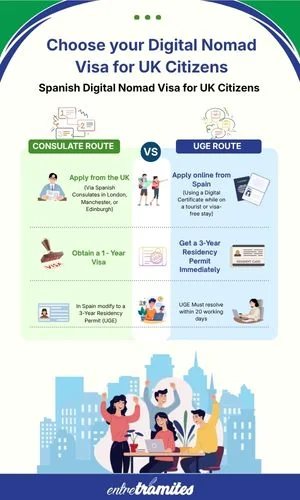
You have two legal paths to obtain this visa. Applying at a Spanish Consulate in the UK grants a 1-year visa. Applying directly from within Spain (entering as a tourist) via the UGE portal grants a 3-year residence permit (TIE). We strongly recommend the UGE route for its speed and longevity.
- Gather Apostilled Documents: Obtain an official UK ACRO Police Certificate proving no criminal record for the last 5 years (Note: You must also provide background checks from any other country where you resided for more than 6 months during the past 5 years).
The original physical certificate must be legalized with the Hague Apostille issued by the UK FCDO and translated into Spanish exclusively by a MAEC-appointed Spanish Sworn Translator (Traductor Jurado).
Timing Warning: Spanish immigration authorities require criminal background certificates to be recent—typically issued within 3 months of your visa or residency application submission. Do not order it too far in advance, or it may expire before your submission date.
- Obtain Company Authorization: For employees, your UK employer must issue a formal letter confirming your remote role and explicitly authorizing you to perform your duties from Spain.
- Prove Income (3 to 12 months):
Employees: Submit the last 3 months of payslips along with matching bank statements, an official employer letter authorizing remote work from Spain, and proof of company registration (at least 1 year old).
Freelancers: Provide 6 to 12 months of issued invoices and matching bank statements demonstrating steady, reliable income above the threshold, alongside commercial contracts establishing a relationship with non-Spanish clients for at least 3 months.
- Acquire Private Health Insurance: Purchase a comprehensive Spanish health insurance policy. It must have zero co-payments and no waiting periods (sin copagos ni carencias).
- Submit via the UGE Portal: Submit the complete dossier electronically using a Digital Certificate. By law, the UGE must resolve your application within 20 working days.
- Register in Spain: Once approved, register your address at the local town hall (Empadronamiento) and apply for your physical Foreigner Identity Card (TIE) via the National Police.
Tax Advantages: The Beckham Law
One of the most attractive aspects of relocating under the Digital Nomad Visa structure in Spain is the associated tax benefit. Eligible remote workers may opt into the Special Tax Regime for Inpatriates, commonly known as the Beckham Law (Article 93 LIRPF).
Instead of paying Spain’s standard progressive personal income tax (which ranges from 19% up to 47% depending on the autonomous region), eligible employed remote workers can apply for this special regime. This allows them to pay a flat 24% tax rate on employment income up to €600,000 per year for up to six fiscal years.
(Note: The Beckham Law specifically targets individuals with an employment relationship. Standard self-employed freelancers working independently generally do not qualify unless operating through specific corporate/start-up structures approved under the law).
When considering what is a digital nomad lifestyle, UK citizens should weigh this massive tax advantage against the initial administrative setup requirements.
Frequently Asked Questions (FAQs)
Can I bring my family if I apply for the digital nomad visa?
Yes. You can include your spouse or civil partner and dependent children. However, the financial requirement increases by 75% of the SMI for your partner and 25% for each additional child.
Do I pay taxes in Spain if I work for a UK company?
Yes. Living in Spain for more than 183 days in a calendar year automatically makes you a Spanish tax resident, meaning you are liable to pay taxes in Spain on your worldwide income. However, employed digital nomads can apply for the Beckham Law (via Form 149 within 6 months of registration) to pay a flat 24% tax rate on their UK employment income, avoiding Spain’s higher progressive tax brackets.
Can freelancers apply for the digital nomad visa?
Yes, self-employed professionals can apply. The primary condition is that at least 80% of your invoicing must come from clients outside of Spain. Only a maximum of 20% of your income can derive from Spanish companies.
Relocating to Spain post-Brexit is entirely possible for remote professionals who meet the legal framework established by the Startup Law. By gathering the precise financial documentation, legalizing your UK criminal records, and managing your tax strategy early, you can seamlessly transition your career to the Mediterranean. Relying on expert immigration and tax advisors guarantees your application meets the UGE’s strict criteria on the first attempt, preventing costly delays or rejections.
If you need personalized assistance, at Entre Trámites we offer management and advisory services on immigration matters. You can contact us through this contact form for us to call you, or if you prefer, you can schedule a free consultation or write to us on WhatsApp.