If you are planning to further your education in Europe, Spain is likely at the top of your list. However, before you pay any tuition fees or sign a rental contract, it is critical to understand exactly which academic programs qualify for legal residency. A Spanish student visa (technically known as an estancia por estudios) is your legal gateway to live, study, and seamlessly transition into the labor market in the country.
Following the recent reforms to the Spanish Immigration Regulations, the government has clarified and expanded the list of valid studies for 2026. This article breaks down every recognized educational category so you can apply with confidence and avoid unexpected administrative rejections.
Higher Education: The top route for a spanish student visa
The most common and secure path to obtain a Spanish student visa is enrolling in higher education. The current legal framework groups these into two main blocks: university and non-university higher studies.
University Degrees
If you enroll in a Spanish university, your studies are almost certainly valid. This includes Bachelor’s degrees (Grados), official Master’s degrees (Másteres oficiales), and PhD programs (Doctorados). Certain university-specific private titles (Títulos propios) are also accepted, provided the institution is properly accredited by the educational authorities.
Non-University Higher Education
Many international applicants do not realize that you do not need a traditional university degree to qualify. Higher Vocational Training (Formación Profesional de Grado Superior or FP), Higher Artistic Studies, and Higher Sports Education are all perfectly valid. In Spain, an FP is a highly practical, two-year technical degree that is heavily demanded by employers.
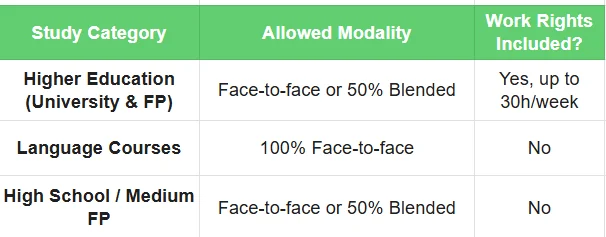
Work advantage: One of the biggest perks of enrolling in any of these higher education programs is that your Spanish student visa automatically grants you the right to work up to 30 hours per week, as long as the work schedule does not overlap with your mandatory classes.
Post-Compulsory Secondary Education
If you are a younger student or looking for medium-grade technical training, the Spanish law also accommodates post-compulsory secondary studies.
High School and Exchange Programs
Enrolling in a Spanish high school (Bachillerato) or participating in a recognized pupil mobility exchange program allows you to obtain the visa.
Medium-Grade Vocational Training
Similar to higher vocational training, the Medium-Grade FP (Formación Profesional de Grado Medio) is fully recognized.
Important limitation: Unlike higher education, studies at this secondary level do not automatically grant you the right to work. Your stay is strictly limited to academic purposes.
Language Courses and Specialized Training
Spain is famous for its language schools, but this is where many applicants make costly mistakes. Not every local academy will grant you legal residency.
Language academies
Many foreign citizens use a language course as an entry point to Spanish culture before committing to a university degree. For a language course to be valid, it must be a full-time program (minimum 20 hours per week) and the institution must be officially recognized. Specifically, if you are studying Spanish, the academy must be explicitly accredited by the Instituto Cervantes; otherwise, your application will face rejection.
Healthcare specializations and professional certificates
The regulations specifically recognize training courses aimed at preparing students for specialized medical exams in Spain (such as the MIR for doctors or EIR for nurses). Additionally, Level 2 and Level 3 Professional Certificates (Certificados de Profesionalidad) are explicitly valid routes to obtain your visa.
Crucial requirements for your course to be approved
Even if your chosen subject is on the approved list, the format of the course must meet strict administrative criteria.
Face-to-face attendance is mandatory
Purely online courses are strictly excluded. To qualify for a Spanish student visa, your program must be delivered in person (presencial). The administration does allow for blended learning (semipresencial), but you must prove that at least 50% of the teaching hours require your physical attendance at the educational center in Spain.
Institutional accreditation
The Spanish government will only approve visas for courses taught at authorized centers. Before paying your enrollment fee, verify that your chosen university or school is registered in the official State Registry of Non-University Educational Centers or the Registry of Universities, Centers, and Titles (RUCT).
Financial and health insurance prerequisites
Once you have secured an acceptance letter from a valid institution, you must prove you can support yourself financially.
You will need to demonstrate sufficient economic means, which is pegged to the Spanish IPREM index. You must prove you have 100% of the monthly IPREM (approximately 600 euros per month) for the entire duration of your stay. If your parents are sponsoring your education, you will need to provide a notarized letter of financial support and their bank statements.
Additionally, you must purchase a comprehensive private health insurance policy from a company authorized to operate in Spain. The policy must have zero co-payments (sin copagos) and no waiting periods (sin carencias), offering immediate coverage equivalent to the Spanish public healthcare system.
Frequently Asked Questions (FAQs)
Can I work while holding a Spanish student visa?
Yes, under the latest regulations, if you are enrolled in higher education (such as a university degree or Higher Vocational Training), your visa automatically allows you to work up to 30 hours per week, provided the job does not interfere with your class schedule.
Are online courses valid to apply for a student visa in Spain?
No. Purely online courses are not valid. The program must be entirely face-to-face or, in the case of blended learning, require at least 50% physical attendance at the educational center in Spain.
Does a language course qualify me for a student residence permit?
Yes, but with strict conditions. The language course must be full-time (at least 20 hours per week) and taught at an officially recognized institution. For Spanish courses, the school must be accredited by the Instituto Cervantes.
If you want to ensure your academic adventure starts without legal hiccups, navigating the immigration system requires an expert team. at Entre Trámites we offer management and advisory services on immigration matters. You can contact us through this contact form for us to call you, or if you prefer, you can schedule a free consultation or write to us on WhatsApp.