Relocating to the Iberian Peninsula for work or to launch a business is exciting, but navigating a foreign tax system is often the biggest hurdle. Fortunately, the Spanish government offers one of the most attractive tax incentive schemes in Europe.
The Beckham Law in Spain is a special tax regime designed to attract international talent, remote workers, and entrepreneurs. Originally introduced in 2005, the law was significantly expanded under the recent Startup Law. In 2026, it remains the ultimate tool for foreigners looking to optimize their taxes while enjoying the Spanish lifestyle.
This guide explains how the regime works, the updated requirements, and how to apply without missing the strict legal deadlines.
What is the Beckham Law in Spain?
Officially known as the Special Tax Regime for Displaced Workers, this framework allows qualifying individuals to be taxed under Non-Resident Income Tax rules, despite legally living in the country.
Under standard rules, spending over 183 days in the country makes you a tax resident, requiring you to pay personal income tax (IRPF) on your worldwide income at progressive rates up to 47%.
By successfully applying for the Beckham Law in Spain, you shield your foreign passive income and pay a reduced, flat tax rate on your salary. This special status applies for the fiscal year you arrive plus the following five years, providing six years of massive tax savings.
Unpacking the Financial and Tax Benefits
If you secure this status, the financial advantages go far beyond a simple income tax reduction. Here is exactly how your wealth is treated:
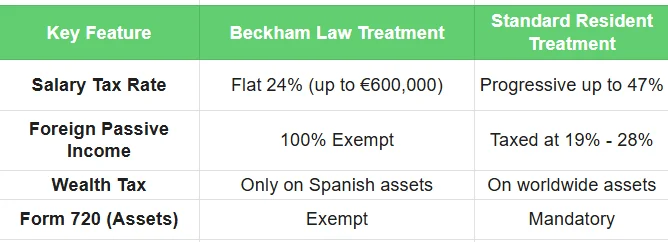
Flat Income Tax Rate: Your employment income (up to €600,000 per year) is taxed at a flat 24%. Any earnings exceeding this threshold are taxed at 47%.
Zero Tax on Foreign Passive Income: You will not pay any Spanish taxes on foreign-sourced dividends, interest, rental income, or capital gains. You are only taxed on passive income generated physically within Spanish territory.
Limited Wealth Tax Exposure: Beneficiaries are only subject to the Spanish Wealth Tax and the Solidarity Tax for assets located strictly inside Spanish borders. Your global portfolio remains untouched.
Exemption from Form 720: You are completely exempt from filing Modelo 720, the mandatory informative declaration of overseas assets.
Core Requirements: Who Qualifies?
Recent legal reforms modernized the regime, opening the doors to a much wider array of professionals. To qualify, you must meet the following strict criteria:
The 5-Year Non-Residence Rule
You must not have been a tax resident in the country during the five years immediately preceding your relocation. (Note: Older articles cite a 10-year rule, but this was permanently reduced by the Startup Law).
A Valid Reason for Relocation
Your move must be strictly triggered by one of these professional reasons:
- Employment Contract: A job offer from a Spanish company or a transfer to a Spanish branch.
- Digital Nomad Visa: Holding the International Telework Visa and working remotely for a foreign employer.
- Company Director: Appointed as an administrator. If it is a passive holding company, you cannot own more than 25% of its capital.
- Entrepreneurial Activity: Launching an innovative startup with a favorable evaluation report from ENISA.
The Causality Principle
The chronological order of your move matters. Your contract, visa, or director appointment must be the direct cause of your relocation. Moving first and finding a qualifying job later will result in rejection.
Can You Include Your Family Members?
Yes. A celebrated update to the Beckham Law in Spain is the inclusion of family members. You can now bring your spouse and your children under 25 years old (or disabled children of any age).
They will also benefit from the 24% flat tax rate and worldwide income shielding. However, the total income generated by your family members cannot exceed your own income as the main applicant. They must also meet the 5-year prior non-residence requirement.
Deadlines and the Application Procedure
The biggest mistake expats make is missing the legal window to apply. The Spanish administration is completely unforgiving regarding deadlines.
You have exactly six months to submit your application using Form 149 (Modelo 149). This non-extendable countdown starts the moment you register with the Spanish Social Security system or the start date listed on your employment documentation—whichever happens first.
Do not wait for your physical TIE card before dealing with your taxes. Immigration bureaucracy is often slower than the six-month fiscal window. If you miss this deadline, you permanently lose the right to the regime.
Once approved, the Tax Agency issues a certificate confirming your status to present to your employer. Instead of filing the standard annual tax return, you will file Form 151 (Modelo 151) during the regular tax season to declare your income.
Taking advantage of the Beckham Law in Spain requires meticulous planning before you pack your bags. A chronological error in your paperwork or a missed deadline can cost you thousands of euros.
Frequently Asked Questions (FAQs)
Can digital nomads apply for the Beckham Law in Spain?
Yes. Following the recent Startup Law reforms, remote workers who hold the International Telework Visa (Digital Nomad Visa) and work for non-Spanish companies are fully eligible to apply for this special tax regime.
What happens after the six-year period of the special tax regime expires?
Once the maximum duration of six fiscal years (the year of arrival plus five subsequent years) ends, you will automatically transition to the general Spanish tax system. From that point forward, you will be taxed as a standard resident on your worldwide income at progressive rates.
Do I have to declare my foreign bank accounts and properties?
No. One of the major benefits of this regime is the exemption from filing Form 720 (Modelo 720). Because you are treated as a non-resident for tax purposes, you do not have to declare assets, properties, or bank accounts located outside of Spanish territory.
Taking advantage of the Beckham Law in Spain requires meticulous planning before you pack your bags. A chronological error in your paperwork or a missed deadline can cost you thousands of euros. If you need personalized assistance, at Entre Trámites we offer management and tax advisory services for freelancers and SMEs. You can contact us through this contact form for us to call you, or if you prefer, you can schedule a free consultation or write to us on WhatsApp.