Welcome to the vibrant Spanish property market! Whether you dream of a coastal villa in Andalusia, a chic apartment in Madrid, or an investment property in Valencia, buying a home here is a thrilling journey. However, before you sign the deed and pop the champagne, you need to understand how the system works. Navigating Real Estate Taxes in Spain might seem daunting for foreigners, but it is completely manageable when you break it down into clear steps.
To complete any property transaction and pay your taxes, you will first need a NIE (Número de Identidad de Extranjero, your Foreigner Identity Number). Once you have this sorted, let’s explore exactly what you will owe to the Spanish tax authorities at every stage: buying, maintaining, and selling your Spanish home.
Understanding Real Estate Taxes in Spain When Buying
When purchasing a home, your tax obligations depend heavily on whether you are buying a brand-new build directly from a developer or a resale property from a previous owner.
Buying a Brand New Property
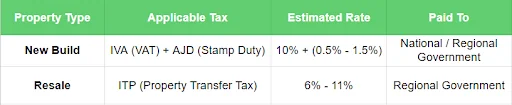
If you are the very first owner of a newly built home, you are required to pay IVA (Impuesto sobre el Valor Añadido, the Spanish equivalent of Value Added Tax). Throughout 2026, the standard IVA rate for residential properties sits at 10% of the purchase price across mainland Spain.
Alongside IVA, you are also liable for AJD (Actos Jurídicos Documentados, which translates to Stamp Duty). AJD rates are determined by the autonomous community where the property is located, typically ranging from 0.5% to 1.5%.
Buying a Resale PropertyFor second-hand homes, IVA does not apply. Instead, you must pay ITP (Impuesto sobre Transmisiones Patrimoniales, or Property Transfer Tax). The ITP rate is set by the regional government and varies significantly across the country. For instance, in Madrid, the ITP is generally around 6%, while in regions like Catalonia or the Balearic Islands, it can scale up to 10% or even 11% depending on the property’s value.
Taxes to Pay While Owning Property in Spain
Once you have the keys and officially become an owner, your fiscal responsibilities shift to ongoing maintenance taxes. Your residency status plays a massive role in how much you pay.
IBI (Local Property Tax)
Every property owner, resident or not, pays IBI (Impuesto sobre Bienes Inmuebles). This is your annual local council tax used to fund community services like street lighting and garbage collection. You pay it directly to your local town hall (Ayuntamiento). The amount is based on the cadastral value (Valor Catastral—the administrative value of your property) and the local tax rate.
Wealth Tax
Spain applies a Wealth Tax (Impuesto sobre el Patrimonio) on your worldwide assets if you are an official tax resident, or strictly on your Spanish assets if you are a non-resident. Generally, there is a generous tax-free allowance of €700,000 per person. If your Spanish real estate pushes your net worth above this threshold, you may need to file a declaration.
IRNR for Non-Residents
If you are a non-resident owner, you must file the IRNR (Impuesto sobre la Renta de No Residentes, the Non-Resident Income Tax) annually with Hacienda (the Spanish Tax Agency). How you pay depends on how you use the home:
- If you rent it out: You pay tax on your actual rental income. European Union (EU) citizens pay 19% and can deduct property expenses. Non-EU citizens (like UK or US expats) pay a flat 24% and cannot deduct expenses.
- If you do not rent it out: Spain still taxes you on an “imputed income” just for owning the property. This is usually calculated as 1.1% or 2% of the cadastral value, which is then taxed at 19% (for EU citizens) or 24% (for non-EU citizens).
Real Estate Taxes in Spain When Selling Your Property
When it is time to sell your sunny retreat, two main taxes come into play. Preparing for these will ensure you calculate your actual net profit accurately and avoid surprises.
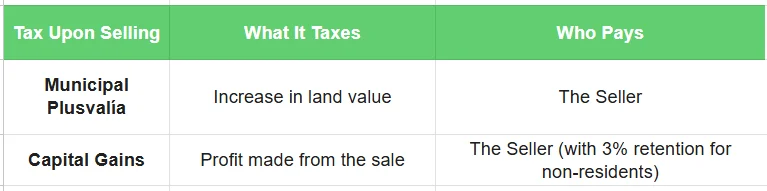
Municipal Plusvalía
The Plusvalía Municipal is a local land value tax paid to the town hall. It strictly taxes the theoretical increase in the value of the land upon which your property sits, from the exact day you bought it until the day you sell. The final calculation depends on the years of ownership and the specific coefficients applied by your local municipality.
You must declare the profit made from the sale (the difference between your original purchase price and your final selling price, minus allowable expenses). For non-residents, Capital Gains Tax is generally charged at a flat rate of 19%.Important note for non-resident sellers: When a non-resident sells a property, the buyer is legally required to withhold 3% of the purchase price and pay it directly to the tax authorities. This acts as a guarantee to ensure you file your final tax return and settle your Capital Gains bill. If your final tax bill is less than the 3% withheld, you can claim a refund.
Handling Real Estate Taxes in Spain does not have to be a headache. By budgeting for ITP or IVA during your purchase, keeping up with your annual IBI and IRNR filings, and understanding your capital gains liabilities, you can enjoy your Spanish property with absolute peace of mind. Always keep your documents organized and consider consulting a registered tax advisor to ensure you are taking advantage of any available regional deductions.
Frequently Asked Questions (FAQs)
Do I have to pay taxes in Spain if I only use my property for summer holidays?
Yes. Even if you only visit your Spanish home for a few weeks a year, as a non-resident owner, you are legally required to pay the annual local property tax (IBI) and the imputed income tax (IRNR) based on the property’s cadastral value.
What happens if I don’t pay the 3% retention when buying from a non-resident?
As the buyer, it is your legal obligation to withhold the 3% from the purchase price and pay it to the Spanish Tax Agency using Form 211. If you fail to do this, the tax debt becomes attached to the property itself, meaning you could be held liable for the seller’s unpaid taxes.
Can I deduct renovation costs to lower my Capital Gains Tax when selling?
Yes, but only substantial structural improvements or extensions that genuinely increase the property’s value can be deducted. General maintenance, painting, or minor repairs do not count. You must have official, valid VAT invoices for all the works you claim.
If you need personalized assistance, at Entre Trámites we offer management and tax advisory services for freelancers and SMEs. You can contact us through this contact form for us to call you, or if you prefer, you can schedule a free consultation or write to us on WhatsApp.