Trading the fast-paced American lifestyle for a relaxed life in the Mediterranean is a dream come true for many US citizens. Spain offers spectacular weather, world-class healthcare, and a remarkably lower cost of living. However, before you pack your bags and order your first plate of jamón, you must address the elephant in the room: the tax system.
When comparing taxes in Spain vs USA, you quickly realize that you are dealing with two entirely different philosophies of taxation. Navigating this overlap can feel like a bureaucratic maze, but it does not have to be a nightmare. By understanding the basics, you can optimize your finances, stay fully compliant in both countries, and focus on enjoying your new life abroad.
The fundamental difference: Citizenship vs. Residency
The biggest hurdle for Americans moving abroad is understanding that the United States is one of the few countries in the world that taxes based on citizenship. No matter where you live, you must file an annual tax return with the IRS.
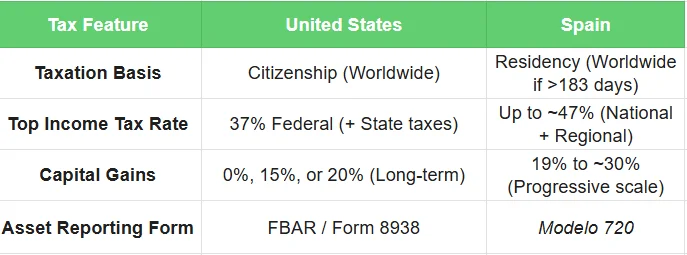
Spain, on the other hand, taxes based on residency. The primary rule to remember is the 183-day rule. If you spend more than 183 days within a single calendar year on Spanish soil, Hacienda (the Spanish Tax Agency) officially considers you a tax resident. This means Spain claims the right to tax your worldwide income, regardless of where that money was generated.
What happens to your US salary or pension?
Even if your income comes entirely from a US-based employer, a US pension fund, or American real estate rentals, Hacienda requires you to declare it. You are legally obligated to report this global income during the Spanish tax season, which typically runs from April to June for the previous calendar year.
Breaking down the rates: Income and Capital Gains
Another major shock when looking at taxes in Spain vs USA is the actual tax rate. Generally speaking, Spain is a higher-tax jurisdiction than the US, especially for high earners.
Comparing income tax brackets
In the US, you pay federal income tax and, depending on where you live, state income tax. In Spain, your income is subject to IRPF (Impuesto sobre la Renta de las Personas Físicas – Personal Income Tax). This tax is split into two parts: a national state rate and a regional rate determined by the Autonomous Community where you live (e.g., Catalonia, Andalusia, or Madrid). The top progressive IRPF brackets in Spain can reach up to 47% or 48% for high earners.
How investment income is treated
If you plan to live off investments or FIRE (Financial Independence, Retire Early), capital gains are treated differently in both countries. In the US, you benefit from favorable long-term capital gains rates. In Spain, this is classified as “savings income” and is taxed progressively. For the 2026 tax year, the savings tax rates generally start at 19% and can go up to nearly 30% for massive investment returns.
To give you a clearer picture, here is a quick visual comparison:
Will I be taxed twice? The US-Spain Tax Treaty
A major fear when evaluating taxes in Spain vs USA is the prospect of paying twice the same dollar. Fortunately, the United States and Spain have a robust double taxation treaty in place. This agreement ensures that you will not pay tax twice on the same income, though you will generally end up paying the higher of the two tax rates.
Tools to reduce your burden
To prevent double taxation, your US tax professional will typically use two main tools when filing your IRS return:
- The Foreign Earned Income Exclusion (FEIE): This allows you to exclude a certain amount of your foreign-earned income from your US taxes.
- The Foreign Tax Credit (FTC): This is often more beneficial for expats in Spain. Since Spanish taxes are usually higher than US taxes, you take the amount of tax you paid to Hacienda and use it as a dollar-for-dollar credit against your US tax bill. This usually wipes out your US tax liability entirely and leaves you with carryover credits for future years.
Hidden surprises: Wealth Taxes and Asset Reporting
To fully master taxes in Spain vs usa, you need to look beyond just your salary. Both countries are incredibly strict about reporting overseas assets.
The FBAR vs. Modelo 720
As a US citizen, you already know about the FBAR—the requirement to report foreign bank accounts if their combined value exceeds $10,000. Spain has its own, much stricter version called Modelo 720. If you are a Spanish tax resident, you must declare overseas assets (bank accounts, investments, and real estate) if any of those categories exceed €50,000. Penalties for failing to file this informational form can be quite severe.
The Spanish Wealth Tax
Unlike the US, Spain has an Impuesto sobre el Patrimonio (Wealth Tax). This is an annual tax on the total net value of your global assets. The good news? It varies heavily by region. Some regions, like Madrid and Andalusia, offer massive exemptions that effectively nullify this tax for almost everyone, making them incredibly popular destinations for high-net-worth expats.
Moving to Spain does not mean sacrificing your financial well-being; it simply means adjusting your strategy. While the Spanish system demands a higher percentage of your income, the trade-off is drastically cheaper healthcare, affordable property, and a superior quality of life. By working with a dual-qualified tax advisor who understands both the IRS and Hacienda, you can navigate these complex waters legally, efficiently, and with complete peace of mind.
Frequently Asked Questions (FAQs)
Does the comparison of taxes in Spain vs USA favor retirees?
Generally, Spain is highly favorable for US retirees. Under the double taxation treaty, US Social Security and government pensions are usually taxed only by the United States, keeping them completely safe from Spanish IRPF rates. However, private pensions and 401(k) withdrawals are usually taxable in Spain.
Can I avoid Spanish tax residency by living there for less than six months?
Yes. If you spend fewer than 183 days in Spain per calendar year (and your primary center of economic interest is not in Spain), you will generally be classified as a non-resident for tax purposes. You will only pay Spanish taxes on income generated directly within Spain, such as rental income from a Spanish property.
Do I still have to pay US state taxes if I live in Spain?
This depends heavily on the US state you lived in right before moving. Some states (like Texas or Florida) have no state income tax, while “sticky” states (like California or New York) make it very difficult to break tax residency. You should formally sever ties with your state before your move to avoid lingering state tax liabilities.
If you need personalized assistance, at Entre Trámites we offer management and tax advisory services for freelancers and SMEs. You can contact us through this contact form for us to call you, or if you prefer, you can schedule a free consultation or write to us on WhatsApp.