The end of the year brings the perfect opportunity to review your finances, organise your accounting, and discover how to reduce tax bill before the calendar closes. In Spain, both resident individuals and self-employed professionals (freelancers or autónomos) can take advantage of various deductions, allowances, and tax-efficient investment tools to lower their Personal Income Tax (IRPF) obligations. By planning ahead, you can optimise your savings, comply smoothly with the Spanish Tax Agency (Agencia Tributaria), and avoid overpaying when the spring tax season arrives.
Strategies on how to reduce tax bill effectively
When looking to lower your Spanish tax burden, several proven strategies can maximise your savings. The key rule of tax planning is to act before December 31st; any transaction or investment made after this date will strictly apply to the following fiscal year.
Maximise contributions to pension plans
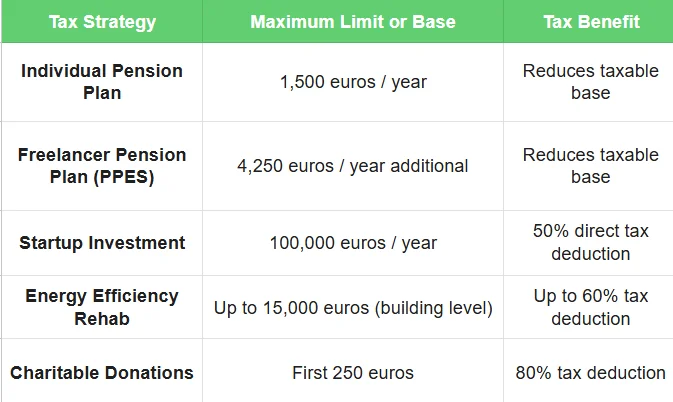
One of the most popular and straightforward methods to lower your taxable income in Spain is contributing to a pension plan. The current regulation caps individual pension plan contributions at 1,500 euros per year. These contributions are directly subtracted from your general tax base (base imponible general), reducing the total amount upon which your progressive tax rate is calculated.
However, there are extended benefits for corporate environments and self-employed workers. If you are an employee, your company can contribute up to an additional 8,500 euros to an employment pension plan on your behalf, bringing the combined maximum to 10,000 euros annually. Furthermore, if you are a freelancer, you are allowed to contribute an additional 4,250 euros to a simplified employment pension plan (PPES) linked to your professional activity. Spouses who earn less than 8,000 euros a year can also receive contributions up to 1,000 euros, which are deductible for the contributing partner.
Take advantage of energy efficiency and EV deductions
Spain strongly incentivises sustainable investments, offering significant relief for eco-friendly upgrades. If you own a property and carry out certified renovation works that improve its energy efficiency, you can deduct between 20% and 60% of the invested amount, depending on the energy savings achieved and certified by a technician. The maximum deduction base for complete building rehabilitations can reach up to 15,000 euros.
Additionally, purchasing a plug-in electric vehicle (EV) or installing a domestic charging station grants you a 15% tax deduction on your IRPF. The maximum deduction base is 4,000 euros for the charging point and up to 20,000 euros for the vehicle, provided you meet the specific deadlines and conditions set by the government.
Invest in startups and newly created companies
Under the recently updated Spanish Startup Law, investing in newly created, innovative companies is a powerful strategy. Taxpayers can deduct 50% of the invested amount in certified startups, with the maximum deduction base substantially increased to 100,000 euros. This not only supports local entrepreneurship but is also one of the most effective ways if you are wondering how to reduce tax bill as a private investor or business angel. To qualify, you must hold the shares for a minimum period of three years and not own more than 40% of the company’s capital.
Additional deductions to lower your Spanish Personal Income Tax (IRPF)
Offset capital gains with losses
If you have sold assets (such as stocks, crypto, or real estate) at a profit during the year, you will be required to pay taxes on those capital gains under the savings tax base (base del ahorro). However, another smart move when looking at how to reduce tax bill is to offset these gains by selling other underperforming assets at a loss before the year ends. Spanish tax law allows you to compensate capital losses against capital gains. If your overall balance for the year remains negative, you can even carry that negative balance forward to offset gains in the next four consecutive years.
Donating to regulated NGOs, foundations, and non-profit organisations offers significant and immediate tax relief. Currently, the Spanish tax system allows you to deduct 80% of the first 250 euros donated. For any amount exceeding 250 euros, the deduction is 40%. To reward loyalty, if you have donated to the exact same entity consistently over the past three years with an equal or greater amount, the deduction on the excess increases to 45%.
Use long-term savings plans (Plan de Ahorro 5)
For conservative investors seeking tax-free growth, the Plan de Ahorro 5 (SIALP for insurance or CIALP for bank accounts) allows you to invest up to 5,000 euros annually. If you commit to holding the investment for at least five full years without withdrawing any funds, all the returns and dividends generated are completely exempt from personal income tax.
Plan ahead and review your tax base
To maximise your tax savings, it is crucial to estimate your expected tax liabilities for 2026 before the end of the year. Assess your net income and review your deductible expenses meticulously—especially if you are self-employed, as every legitimate business expense directly reduces your net income.
Moreover, do not forget to check for any specific regional deductions (deducciones autonómicas) offered by the Autonomous Community where you reside as a tax resident. Many regions offer generous additional benefits for renting your primary residence, specific educational expenses, birth and adoption, or adapting a home for people with disabilities.
Taking decisive action before the year concludes is the only guaranteed way to secure these financial benefits. Understanding how to reduce tax bill effectively allows you to reinvest your hard-earned money and maintain a healthier long-term financial profile in Spain.
Frequently Asked Questions (FAQs)
Can I deduct rent on my Spanish tax return?
It depends on your Autonomous Community. While the state-level deduction for tenants was abolished for contracts signed after 2015, almost all Spanish regions offer their own specific deductions for renting a primary residence, especially for young people or seniors.
What is the maximum I can put into a pension plan to lower taxes?
Currently, the individual limit for pension plan contributions is capped at 1,500 euros per year. However, this can be increased if you have an employment pension plan provided by your company (up to 8,500 euros extra) or if you are self-employed and contribute to a simplified employment pension plan (up to 4,250 euros extra).
Do investments in foreign startups qualify for the 50% tax deduction?
No, the 50% tax deduction applies exclusively to investments made in newly created or innovative companies that are formally certified by the Spanish government entity ENISA, and which have their registered office in Spain.
Taking decisive action before the year concludes is the only guaranteed way to secure these financial benefits. Understanding how to reduce tax bill effectively allows you to reinvest your hard-earned money and maintain a healthier long-term financial profile in Spain. If you need personalized assistance, at Entre Trámites we offer management and tax advisory services for freelancers and SMEs. You can contact us through this contact form for us to call you, or if you prefer, you can schedule a free consultation or write to us on WhatsApp.