Owning a sunny holiday home in Alicante or an apartment in Barcelona is a dream for many. However, keeping up with Spanish tax obligations from afar can quickly become a source of stress. If you own property in Spain but do not live there full-time, you have a strict legal requirement to settle your taxes with the Agencia Tributaria (the Spanish Tax Agency). This is exactly where the notorious form 210 comes into play.
Handling cross-border taxes does not have to be an intimidating process. In this breakdown, we will explain what this paperwork entails, when you need to submit it, and how to stay perfectly compliant with Spanish law so you can enjoy your investment without worrying about unexpected fines.
What is form 210 and Who Actually Needs to File It?
Simply put, form 210 is the official tax return for the Impuesto sobre la Renta de No Residentes (IRNR), which translates to the Non-Resident Income Tax. You are legally considered a non-resident for tax purposes if you spend less than 183 days a year in Spanish territory and your primary economic interests are based elsewhere.
You must file this document if you meet the non-resident criteria and fall into one of these specific categories:
- You own a property in Spain (even if you leave it completely empty).
- You earn rental income from a Spanish property.
- You recently sold a property in Spain and need to declare the capital gains.
To submit your paperwork, you will absolutely need your NIE (Número de Identidad de Extranjero – a unique identification number assigned to foreigners in Spain) and access to your property’s financial details.
The Three Main Reasons You Must File
Depending on how you use your Spanish property, your tax obligations will look very different. The tax rate applied generally depends on your passport: 19% for citizens of the EU, Iceland, and Norway, and 24% for citizens from non-EU countries.
1. Imputed Income on Empty Properties
Many foreign owners are surprised that Spain taxes empty homes. If you use your Spanish property only for holidays and never rent it out, the government assumes a “fictional” income. This imputed income tax is based on a small percentage (usually 1.1% or 2%) of the Valor Catastral (the rateable property value found on your local council tax bill). For example, if you owned the property in 2025, you must pay this corresponding tax by the end of 2026.
2. Rental Income
If you lease your property—whether it is a long-term contract or a short-term Airbnb setup—you must pay tax on your profits. A major advantage for EU residents is that they can deduct related expenses (like mortgage interest, insurance, and maintenance) from their gross income before applying the 19% rate. Non-EU residents must pay a flat 24% on their gross income with no deductions allowed.
3. Capital Gains When Selling
When selling a Spanish property as a non-resident, the buyer is legally required to withhold 3% of the purchase price and pay it directly to the tax office on your behalf. Afterward, you have a short window to submit your form 210 to declare your actual capital gain. If your final tax bill is lower than the 3% withheld, you can claim a refund for the difference.
Important Deadlines to Keep in Mind
Missing a deadline with the Spanish tax office will automatically trigger surcharges (recargos) and late payment interest. Make sure you respect these current timelines to stay compliant:
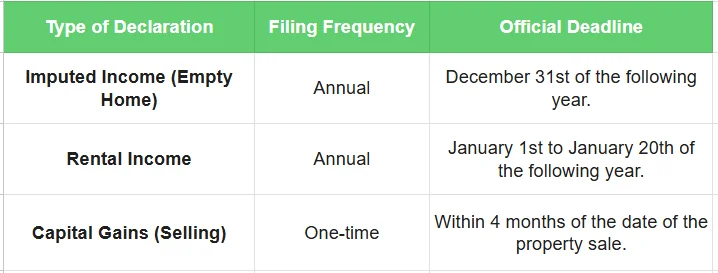
Note: If you choose to pay your tax via direct debit (domiciliación bancaria), you must file your declaration at least five days before the official deadline so your bank has time to process the transaction.
How to Submit Your Declaration
You have a couple of options for submitting your tax return. If you are confident in your Spanish and comfortable with digital bureaucracy, you can file directly through the online portal using a Certificado Digital (a secure digital identity certificate installed on your computer).
However, because the platform is entirely in Spanish and tax calculations must be exact, many expats choose to hire an accountant (gestor) in Spain. A local expert ensures your deductions are correct and your deadlines are met. You can visit the official Spanish Tax Agency website for technical manuals and raw forms, but having a professional handle your form 210 is often the safest route.
Managing your Spanish property taxes is simply part of the cost of enjoying a beautiful home in the sun. By understanding when and why you need to file this specific document, setting reminders for your deadlines, and seeking local expertise when necessary, you ensure your Spanish investment remains a secure and joyful asset.
Frequently Asked Questions (FAQs)
Do I need to file a tax return if my property in Spain is empty all year?
Yes. In Spain, non-resident property owners must pay an imputed income tax even if the property is completely empty and never rented out. The tax is calculated using the official cadastral value of your property.
Can non-EU residents deduct expenses from their Spanish rental income?
No. Under current Spanish tax law, only tax residents of the European Union, Iceland, and Norway can deduct expenses like community fees, insurance, and maintenance from their rental income. Non-EU residents must pay a flat 24% rate on their gross rental earnings.
What happens if I miss the deadline to pay my non-resident property tax?
If you file late, the Spanish tax authority will apply a penalty surcharge that ranges from 1% to 15%, plus delay interest, depending on how many months have passed since the original deadline. It is always better to voluntarily back-file previous years before the tax office sends you an official requirement.
If you need personalized assistance, at Entre Trámites we offer management and tax advisory services for freelancers and SMEs. You can contact us through this contact form for us to call you, or if you prefer, you can schedule a free consultation or write to us on WhatsApp.