Losing a loved one is an incredibly difficult experience, and navigating foreign bureaucracy during such a time can feel overwhelming. If your family member has passed away in Spain, or if you need to settle the Spanish estate of someone who died abroad, obtaining an official death certificate is your unavoidable first step.
Without this document, known locally as the Certificado de Defunción, your legal hands are tied. You cannot access bank accounts, claim life insurance, or process any inheritance. Fortunately, the Spanish government has modernized the system for 2026, making it easier than ever to secure this paperwork remotely. Let’s break down exactly what you need to do, step by step, so you can handle this requirement quickly and focus on what truly matters.
Why the death certificate is Your Most Important Document
In Spain, a doctor issues a medical certificate to confirm the passing, but this is not the legally binding document you need for administrative tasks. The official death certificate is issued exclusively by the Registro Civil (the Civil Registry). You will be asked to provide this document for almost every post-mortem procedure.
Unlocking Bank Accounts and Assets
Spanish banks are notoriously strict. The moment they are notified of a client’s passing, they freeze all accounts to prevent unauthorized withdrawals. To unfreeze them, distribute funds, or change the ownership of a Spanish property, the bank and your local notary will require an original, recently issued certificate.
Filing the Inheritance Tax
Within six months of the passing, the heirs must file the Impuesto de Sucesiones y Donaciones (Inheritance and Gift Tax) with Hacienda (the Spanish Tax Agency). The tax office will not even begin to process your tax filings or calculate your deductions without this civil registry proof.
Repatriation of the Deceased
If the individual was an expat or tourist and the family wishes to transport the body back to their home country, international transport authorities and embassies strictly require the formalized registry document before approving the cross-border transfer.
Understanding the Types of Certificates Available
When you request this paperwork, you cannot just ask for a generic copy. The Spanish Civil Registry offers three different formats, and choosing the wrong one can cause frustrating delays and extra costs.
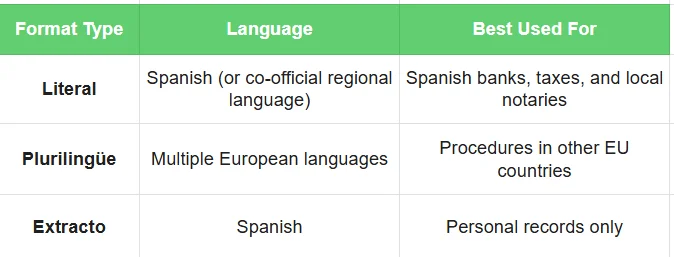
Certificado Literal
This is the most common format. It is a complete, exact copy of the original registration, containing all the details recorded at the time of death. If you are dealing with Spanish authorities, local banks, or a local notary, this is the version you absolutely must request.
Certificado Plurilingüe (International)
Also known as a multilingual certificate, this version is issued in the official languages of all the countries that signed the Vienna Convention. If you need to present the document in another EU country (such as France or Germany) to claim international assets, request this format to avoid paying for an official translation.
Certificado en Extracto
This is merely a brief summary of the registry entry. It lacks the comprehensive legal details of the literal version and is rarely accepted for official legal or financial procedures.
Here is a quick reference table to help you choose the right format:
Step-by-Step: Applying for a death certificate Online
The government provides three distinct pathways to request this document, but applying digitally is by far the most efficient route.
If you have a Certificado Digital (a secure digital identity installed on your computer) or use the Cl@ve system, you can request the document instantly. Simply navigate to the Electronic Headquarters of the Ministry of Justice, select the relevant procedure under the Civil Registry tab, and fill out the deceased’s details (including their full name and DNI/NIE). In most cases, if the death was registered electronically, you can download a digitally signed PDF immediately.
If you do not have digital access, you can apply by post by sending a formal letter to the Civil Registry of the municipality where the death occurred, though this can take several weeks. Alternatively, you can book a Cita Previa (prior appointment) to visit the local Civil Registry in person. Keep in mind that obtaining this document directly from the government is completely free of charge.
The Crucial Next Step: The Last Will Registry
Once you have your certificate in hand, your administrative journey in Spain is not quite over. To claim an inheritance, you must pair it with a Certificado de Últimas Voluntades (Certificate of Last Will and Testament).
This second document proves whether the deceased left a registered Spanish will, and if so, which notary holds the official copy. You cannot request the Last Will certificate until 15 working days have passed since the date of death, and you must present the original Civil Registry document to apply for it. Together, these two documents form the legal foundation required by any Spanish notary to initiate the probate process.
Managing cross-border administrative tasks during a period of grief is challenging, but understanding the system provides much-needed clarity. By knowing exactly which format to request and utilizing the Ministry of Justice’s digital platforms, you can secure your required paperwork efficiently. Take it one step at a time, seek professional guidance if your situation is complex, and protect your family’s legal interests with confidence.
Frequently Asked Questions (FAQs)
Can anyone request this document in Spain?
Generally, yes. The civil registry is public, so any citizen can request it provided they have the necessary identifying details of the deceased. However, in certain sensitive cases, you may need to prove a legitimate interest or present a judicial authorization to access the records.
How much does it cost to get the official document?
Obtaining the document directly from the Ministry of Justice or the local Civil Registry is entirely free of charge. You will only incur costs if you choose to hire a lawyer or a gestor to handle the administrative process on your behalf.
Do I need an apostille if the person died outside of Spain?
Yes. If the death occurred abroad but you need to present the documentation to Spanish authorities (for example, to claim a Spanish bank account), the foreign certificate must bear the Hague Apostille and be officially translated into Spanish by a sworn translator before it will be accepted.
If you need personalized assistance, at Entre Trámites we offer management and tax advisory services for freelancers and SMEs. You can contact us through this contact form for us to call you, or if you prefer, you can schedule a free consultation or write to us on WhatsApp.