Immigration regularization means getting legal status in a country — especially when you’ve been living there without a valid permit or residency. It’s the process of moving from irregular to regular immigration status under the law.
In Spain, this concept includes both traditional legal paths (like arraigo and family routes under the Immigration Law) and a new 2026 extraordinary regularization process designed to help many people who lived in Spain without paperwork become legal.
What “immigration regularization” means in Spain
In Spain, immigration regularization generally refers to ways that allow someone to:
- Legally live and work in Spain.
- Stop being subject to fines, expulsion orders, or uncertain status,
- Apply for official documentation like a TIE (Foreigner Identity Card).
Traditionally, this happened through legal authorizations under Spain’s Immigration Law, such as:
- Arraigo social (social integration residence),
- Family reunification routes,
- Other employment migration permits.
All these are regulated under the Organic Law 4/2000 and its implementing regulations (the Immigration Law and Reglamento de Extranjería).
However, 2026 brings an additional way — the Extraordinary Regularization Process — which could benefit hundreds of thousands of migrants who meet specific conditions.
Why immigration regularization matters
Getting regularized in Spain means legal stability and dignity, including:
- Legal residence and work authorization.
- Access to social security, healthcare, and public services.
- Ability to sign contracts (rent, employment, banking).
- A legal pathway to long-term residence and possibly later citizenship.
Especially with the 2026 extraordinary process, many people who were previously stuck without options may now qualify.
Traditional vs. Extraordinary regularization
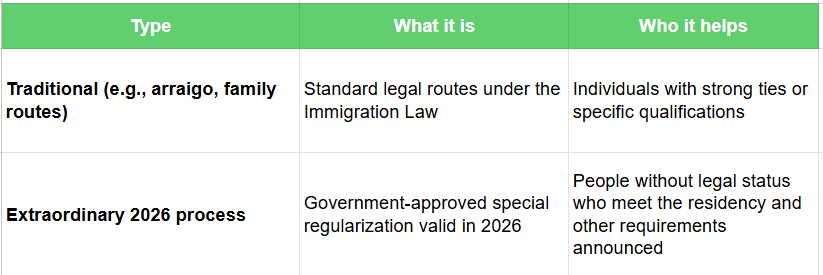
The extraordinary process is a temporary, exceptional procedure aimed at giving legal status to people who already live in Spain but lack a valid permit — without needing the usual employment contract or long-term integration requirements.
What you should know about the 2026 extraordinary regularization
Spain’s government has approved — via a Royal Decree for 2026 — a special regularization process set to begin in April 2026 and last through June 30, 2026, allowing eligible foreign nationals to obtain a one-year residence and work permit.
Who can apply
To qualify for the 2026 extraordinary regularization, a person must generally:
✔ Have been living in Spain before December 31, 2025
✔ Show continuous residence of at least 5 months in Spain by the time of application
✔ Have no criminal record in Spain or their home country
✔ Not pose a public safety, health, or national security risk
Asylum seekers who applied for protection before December 31, 2025, may also be eligible even if their asylum case is still pending.
If approved, applicants receive a residence permit with full work rights valid across Spain.
Why this matters now
This 2026 extraordinary regularization:
- Could benefit hundreds of thousands of migrants who meet the cutoff dates and conditions.
- Is not automatic citizenship — it grants legal status and work rights but does not give immediate voting rights.
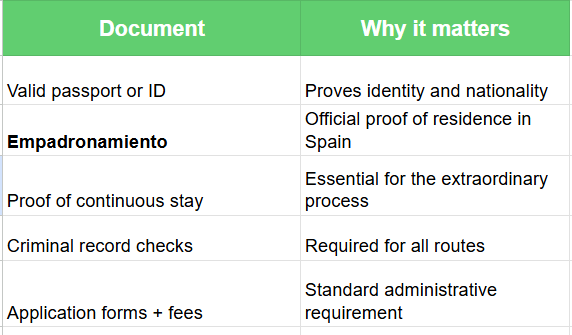
- Requires careful preparation of documentation (passport, proof of residence, criminal record certificates, etc.).
This process is historic in scale and visibility and is often compared to earlier normalization waves in Spain’s history.
Key requirements checklist
Below is a quick checklist of what most people preparing for regularization will need — whether under traditional routes or the 2026 extraordinary process:
Step-by-step: how immigration regularization usually works
- Determine your best legal route: traditional (e.g., arraigo, family) or extraordinary 2026 process.
- Gather documents (identity, residence, criminal records).
- Submit the application during the established period (especially for the extraordinary process).
- Wait for an official decision.
- If approved: schedule a TIE (Foreigner Identity Card) appointment.
Common mistakes to avoid
- Missing the December 31, 2025 cutoff for the extraordinary process.
- Incomplete proof of continuous residence.
- Not checking criminal record criteria for both Spain and the origin country.
- Relying on informal advice rather than official procedures.
Being well prepared today can make a big difference when the application window opens.
Frequently Asked Questions (FAQs)
Does extraordinary regularization guarantee Spanish nationality?
No. It provides legal residence and work authorization, but nationality requires separate long-term residence criteria.
Can asylum seekers apply for the 2026 extraordinary regularization process?
Yes — if they applied for asylum before December 31, 2025, they may be eligible.
When will the regularization application period open and close?
The extraordinary regularization process is expected to open in April 2026 and close around June 30, 2026.
If you’ve been living in Spain without a valid residence permit, understanding immigration regularization is the first step to getting legal stability. In 2026, Spain’s extraordinary regularization process may open a real opportunity for many people who meet the cut-off date and residency conditions, while the usual routes (like arraigo and family options) still remain key alternatives. The smartest move is to prepare early: gather solid proof of residence, make sure your documents are correct and up to date, and choose the route that truly fits your situation—so you can move forward with peace of mind and a clear legal path in Spain.
If you need personalized assistance, at Entre Trámites we offer management and advisory services on immigration matters. You can contact us through this contact form for us to call you, or if you prefer, you can schedule a free consultation or write to us onWhatsApp.